

Campground Hookups Checklist: Before You Plug In
Campground power pedestals aren’t all the same. Voltage can sag on hot afternoons, outlets get worn, and wiring mistakes do happen. This checklist walks you through quick, reliable steps to confirm what’s at the post, pick the right gear, and connect your RV without risking tripped breakers or fried electronics.
Know Your Rig’s Service (30A vs 50A)
Check your RV’s main power inlet and panel rating. Most travel trailers use 30A service (TT‑30, 120V single‑hot), while larger fifth wheels and Class A coaches typically use 50A service (14‑50, 120/240V split‑phase). For a quick refresher on what each powers and why the blades differ, see RV Power Basics: TT‑30 vs 14‑50 Explained with Use Cases.
Before You Arrive: Pack the Right Power Gear
- Service‑matched cord: Bring a cord that matches your rig and typical campsite distance. For 30A rigs, a durable TT‑30 cord like the 30‑Amp Extension Cord for RV (TT‑30P to TT‑30R) provides the correct connectors and gauge for campground runs.
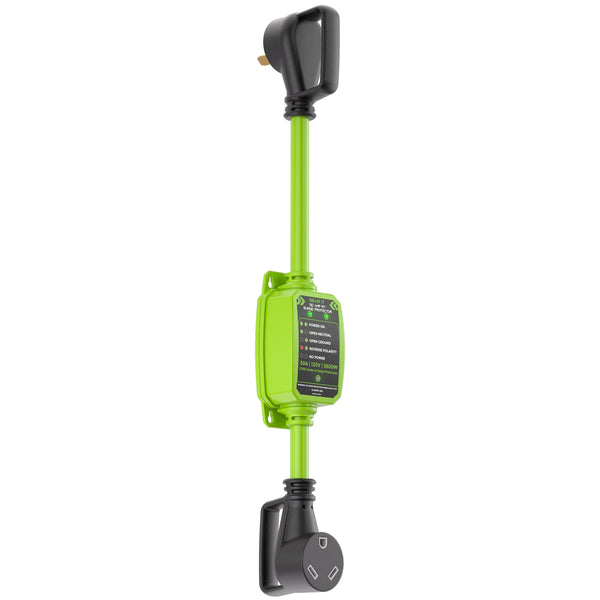
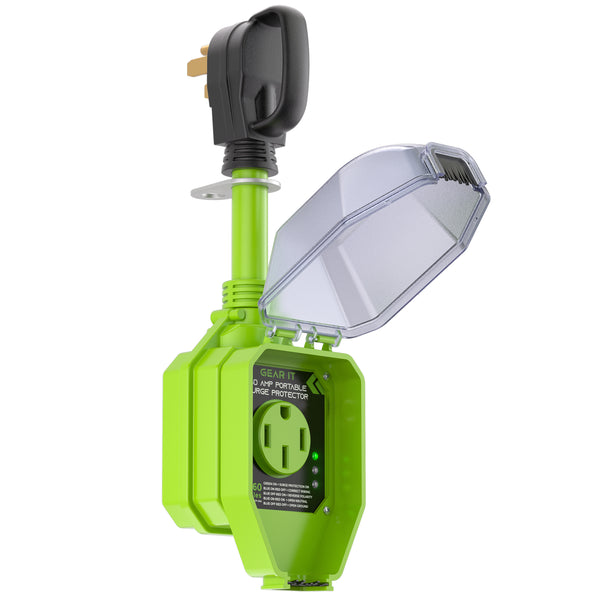
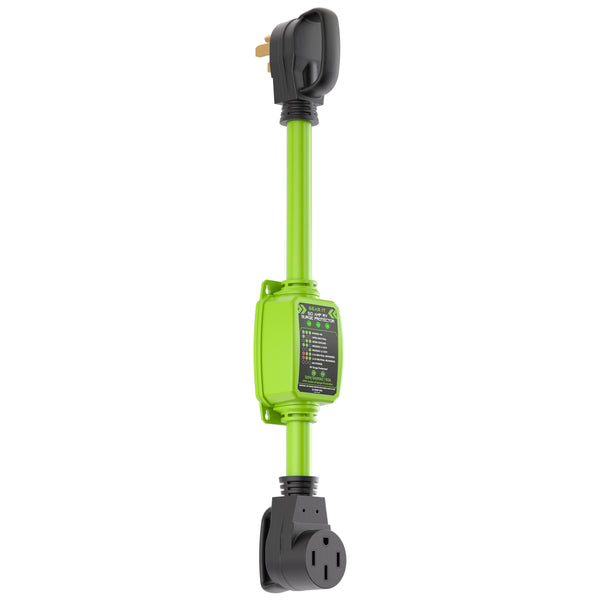
- Surge protection and wiring check: A basic inline protector is fast for go/no‑go checks; an analyzer or smart model adds diagnostics and monitoring. 30A owners can choose a compact protector such as the 30‑Amp RV Surge Protector Plug or step up to app visibility with the 30‑Amp WiFi RV Surge Protector. For 50A coaches, consider the 50‑Amp Heavy‑Duty RV Surge Protector (circuit analyzer) or the weather‑shielded 50‑Amp RV Surge Protector Plug with Cover. For deeper selection advice, see Surge Protection for RVs: 30A vs 50A and When You Need EMS.
- Only the adapters you truly need: Pack dogbones for known scenarios (e.g., generator to RV or limited campground service). Learn safe and unsafe combinations in Adapters and Dogbones: Safe Combinations and What to Avoid.
- Generator hookup option: If you boondock or use a portable generator, confirm your outlet type. A TT‑30P generator output can feed an L5‑30 inlet with a short, heavy adapter like the 30‑Amp TT‑30P to L5‑30R Generator Power Cord. For reach or wattage planning, see Generator Cords: L14‑30 and L5‑30—What They Power and How Far.
At the Pedestal: A Fast Safety Check
- Pedestal inspection: Look for scorch marks, loose covers, or wobbly receptacles. If it looks damaged, request a different site.
- Breaker positions: Turn the pedestal breaker for your outlet OFF before you plug in any device.
- Diagnostic test: Plug your surge protector into the pedestal first. Use its indicator lights or display to confirm proper wiring and adequate voltage. If anything reads open ground, reverse polarity, or low voltage, don’t proceed—ask the campground to fix it. For ongoing visibility, leave a monitor‑capable unit like the 30‑Amp WiFi RV Surge Protector inline so you can watch voltage and current during heat waves and peak usage.
- Connect the RV cord: With the breaker still OFF, firmly seat your RV cord into the surge protector (or directly into the pedestal if you’re not using one). Then flip the breaker ON.
Which Outlet Do You Actually Have?
Pedestals in the U.S. commonly offer TT‑30 (30A, 120V) and 14‑50 (50A, 120/240V). Some sites list both; others only one. If you arrive with a 30A rig to a 50A‑only site, a proper 50A‑to‑30A adapter can work, but you’re still limited by the RV’s 30A main breaker. If you’re unsure which connector blade pattern matches your rig, compare details in RV Power Basics: TT‑30 vs 14‑50 Explained with Use Cases.
30A vs 50A at a Glance
Use this quick matrix to match your hookup to typical use cases and gear.
| Service | Connector | Voltage | Typical Loads | Helpful Gear |
|---|---|---|---|---|
| 30A RV | TT‑30 (3‑prong) | 120V single‑hot | 1 A/C unit, microwave, converter/charger, outlets | 30‑Amp RV Surge Protector Plug; TT‑30 Extension Cord |
| 50A RV | 14‑50 (4‑prong) | 120/240V split‑phase | 2+ A/C units, electric water heater, higher combined loads | 50‑Amp RV Surge Protector (Analyzer) |
Voltage Drop and Cord Length
Long cable runs increase voltage drop and heat. Keep lengths as short as practical and use appropriately thick conductors for the amperage. If you’re stretching to a distant pedestal or temporary generator, plan the gauge and length with the Voltage Drop Calculator: Picking the Right Gauge by Length (30A/50A).
Adapters: Use Case, Not Convenience
Adapters solve specific problems—like connecting a TT‑30 RV to a generator’s L5‑30 twist‑lock or plugging a 30A rig into a 14‑50 pedestal. Avoid daisy‑chains, and never try to “create” more amperage than your RV is designed for. For safe pairing and what to avoid, review Adapters and Dogbones: Safe Combinations and What to Avoid.
Step‑by‑Step: Powering Up Safely
- Confirm service type: Identify TT‑30 or 14‑50 at the pedestal and match to your RV inlet.
- Breaker OFF: Flip the correct pedestal breaker to OFF.
- Test with a protector: Plug in your surge protector to check for correct wiring and healthy voltage. If you want ongoing data, keep a monitor model like the 30‑Amp WiFi RV Surge Protector inline.
- Connect your cord: Seat the plug fully. For 30A, a robust TT‑30 cord such as the TT‑30 Extension Cord helps minimize heat at the blades.
- Breaker ON, then verify loads: Switch ON, then power high‑draw appliances one at a time. If you see dimming lights or hear ACs complain, reduce simultaneous loads.
Regional and Seasonal Tips (U.S. & Canada)
- Summer in the Sun Belt: Late‑day voltage sag is common. A live monitor and conservative appliance use keep compressors happier.
- Mountain West and Upper Midwest: Cold, stiff jackets can be harder to coil. For jacket and storage best practices, read Outdoor Use: STW vs SJTW Jackets, IP Ratings, and Storage.
- Shoulder‑season camping: Inspect gear after storage and before first hookup; see Winterizing Your Power Gear: Inspection and Care.
Common Problems You Can Prevent
- Tripped pedestal breakers: Often caused by overloading or a loose plug. Step down big loads and reseat connections. For quick fixes, see Troubleshooting Tripped Breakers and Hot Plugs.
- Hot or discolored plugs: Indicates resistance from poor contact or undersized/over‑length cable. Shorten the run and use heavy‑gauge cords like the TT‑30 Extension Cord.
- Generator mismatch: Confirm outlet type first; a short adapter such as the TT‑30P to L5‑30R Generator Power Cord solves common twist‑lock scenarios.
Packing List: The 60‑Second Pre‑Plug Checklist
- Surge protector that matches your service (one of: 30‑Amp RV Surge Protector Plug, 30‑Amp WiFi RV Surge Protector, or 50‑Amp RV Surge Protector (Analyzer)).
- Primary RV power cord sized for the distance (TT‑30 Extension Cord for 30A rigs).
- Only essential adapters for known outlets (adapter safety guide).
- Plan for cord length and voltage drop (gauge‑by‑length guide).
Frequently Asked Questions
Do I need a surge protector if the campground is well maintained?
Yes. Even in reputable parks, temporary faults, miswired posts, and brownouts can occur—especially during peak summer loads. A basic plug‑in protector verifies wiring before you connect, and an analyzer or Wi‑Fi model keeps watch while you camp.
Can I run a 30A RV from a 50A pedestal?
With the correct dogbone adapter, yes—but your RV is still limited to 30A by its main breaker. Don’t expect to power additional appliances beyond what your 30A system safely supports. For the full picture, see TT‑30 vs 14‑50.
Why does my plug get warm?
Heat usually points to resistance: worn contacts, a partially seated plug, or excessive length/gauge mismatch. Use shorter, heavy‑gauge cords and reseat connections. If the plug is hot to the touch, disconnect and inspect; review Troubleshooting Tripped Breakers and Hot Plugs.
What’s the simplest upgrade for safer hookups?
Start with an inline protector matched to your service. 30A owners often pick the compact 30‑Amp RV Surge Protector Plug, while 50A owners favor a unit with diagnostics such as the 50‑Amp RV Surge Protector (Analyzer).
Next Steps
If you’re sorting out cable gauge, run length, or cold‑weather handling, these quick reads will help you fine‑tune your setup: 50A RV Cords: Copper Gauge, Jacket Type, and Cold‑Weather Flex and Outdoor Use: STW vs SJTW Jackets, IP Ratings, and Storage. For generator use and distance planning, see Generator Cords: L14‑30 and L5‑30—What They Power and How Far.