

Adapters and Dogbones: Safe Combinations and What to Avoid
Short “dogbone” adapters and splitter cords make it easier to connect RVs, EV chargers, and generators to the power that’s actually available. This guide shows which combinations are safe in the U.S. and Canada, when to use a splitter, and what to avoid so you don’t trip breakers or damage equipment.
Know Your Common Connectors
Most campground and home connections in the United States use these NEMA patterns and voltages:
- TT-30 (30A RV): 120V, 3-prong. Typical for travel trailers and many campgrounds.
- 14-50 (50A RV/EV): 120/240V split-phase, 4-prong. Common at RV pedestals and for EV portable charging.
- L14-30 (30A generator): 120/240V locking, 4-prong. Frequent on portable generators and transfer switches.
- 14-30 and 10-30 (dryer): 240V household dryer outlets; 14-30 has a dedicated ground, 10-30 is older 3‑wire.
- SS2-50 (50A marine/shore): 120/240V locking 50A common on marina pedestals.
- J1772 and Tesla NACS (EV): Vehicle-side charge inlets used with appropriate adapters.
Match the adapter to both the source receptacle and the device inlet. Amperage is always limited by the lowest-rated component and the upstream breaker.
Safe Adapter Pairings (Quick-Choose)
Use this table to identify safe, common scenarios at U.S. campgrounds, residences, and marinas.
| Source Outlet | Voltage / Poles | Device/Inlet | Adapter Type | Safe If You... |
|---|---|---|---|---|
| 14-50 (campground) | 120/240V, 50A | 30A RV (TT-30) | 14-50P to TT-30R dogbone or a dual‑TT‑30 splitter | Limit load to 30A per TT‑30 leg; never exceed pedestal rating. Consider a surge protector. |
| 14-50 (home or campground) | 120/240V, 50A | Two 30A RVs (both TT-30) | 14-50P to dual TT-30R splitter | Keep combined load ≤ 50A and each RV ≤ 30A; monitor heat at connections. |
| TT-30 (campground) | 120V, 30A | 30A RV (TT-30) | Direct cord or TT‑30P accessories | Stay under 30A; avoid chaining multiple reducers. |
| L14-30 (generator) | 120/240V, 30A | TT-30 RV or L14-30 loads | L14‑30P to TT‑30R or L14‑30 splitters | Understand 120V vs 240V legs; don’t overload a single leg. |
| 14-30 (newer dryer) | 240V, 30A | Appliance or EV portable charger | 14‑30 adapters or splitters with ground | Confirm 4‑wire grounding; set EV to ≤ 24A continuous. |
| 10-30 (older dryer) | 240V, 30A | Appliance with 10‑30 plug | 10‑30 splitters/adapters | Avoid for devices requiring a dedicated equipment ground; know local code. |
| SS2-50 (marina shore) | 120/240V, 50A | 14‑50 RV/EV inlet | SS2‑50 to 14‑50 adapter | Inspect for corrosion; keep connections dry and supported. |
What to Avoid (and Why)
- “Backfeeding” or changing voltage with a passive adapter: No dogbone can convert 240V to 120V or the other way around without a transformer or power electronics. Use the right outlet for the device.
- Cheater cords that combine two outlets into one higher‑amp feed: Don’t attempt to tie two outlets together to “make” a larger circuit. It’s unsafe and can bypass breakers.
- Feeding a 120V‑only RV (TT‑30) from a 240V‑only source: You risk damaging appliances. If your only source is 240V, use equipment designed for that or a qualified transformer solution.
- Overdrawing splitters: A splitter doesn’t double available power. Total load is limited by the source breaker (for example, two TT‑30 RVs on one 50A pedestal must share ≤ 50A combined).
- Old 10‑30 dryer circuits where an equipment ground is required: Many modern devices (including some EVSEs) need a dedicated ground, which 10‑30 lacks. Use 14‑30 or another grounded option.
- Undersized wire and long chains of adapters: Extra resistance causes heat and voltage drop. Pick the correct gauge and keep the run short.
- Wet or unsupported connections: Keep plugs off the ground, out of puddles, and protected from strain.
Regional Notes for U.S. Campgrounds and Marinas
Most U.S. RV pedestals provide 50A (14‑50) and 30A (TT‑30) receptacles on separate breakers. Many marinas use SS2‑50 locking connectors. If you camp in wet or cold regions (Pacific Northwest, Upper Midwest, New England), choose heavy‑duty STW jackets and plan for stiffer cords in freezing weather. For jacket types and storage tips, see Outdoor Use: STW vs SJTW Jackets, IP Ratings, and Storage.
Helpful Picks from GEARit
- Power two 30A RVs from a single 50A pedestal: 50 Amp NEMA 14-50P to Dual 30 Amp NEMA TT-30R Splitter Power Cord Adapter balances convenience with proper conductor size. Ideal for friends sharing one site—monitor total load.
- Split a single 30A RV outlet: For two 30A branch connections when the source is TT‑30, use the appropriately gauged 30 Amp NEMA TT-30P to Dual NEMA TT-30R Splitter; keep combined load ≤ 30A.
- Adapt a 30A dryer (4‑wire) with flexibility: When you must bridge 14‑30 to mixed inlets, the 30 Amp NEMA 14-30P to 14-30R and 14-50R Splitter provides grounded connections; set downstream loads within the 30A circuit.
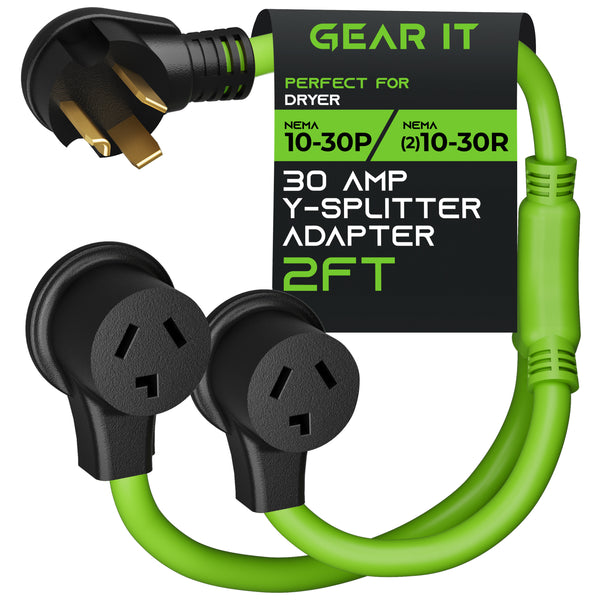
- Working with older 3‑wire dryer outlets: If your appliance specifically accepts 10‑30 and doesn’t require a separate equipment ground, the 30 Amp NEMA 10-30P to Dual NEMA 10-30R Splitter can share one circuit. Avoid for equipment that needs a dedicated ground.
- Charging a J1772 EV from Tesla (NACS) chargers: Use the compact Tesla to J1772 Adapter when a Tesla‑standard destination charger is available and you have a J1772 vehicle.
- Protect your rig while adapting: Add a line‑side analyzer such as the GEARit RV Surge Protector 50 Amp Circuit Analyzer or the rugged 50-Amp RV Surge Protector Plug to check wiring faults and absorb spikes before they reach your coach.
Planning Loads and Cable Length
Adapters don’t increase available power. Plan your loads by amperage and distance, especially on 30A circuits. Longer runs add voltage drop and heat. For a quick sizing refresher tailored to RV power, see 50A RV Cords: Copper Gauge, Jacket Type, and Cold‑Weather Flex and use the Voltage Drop Calculator: Picking the Right Gauge by Length (30A/50A).
Generator and Shore Power Tips
On L14‑30 generator outlets, understand which leg powers which loads and avoid overloading one side. For distance and output planning, see Generator Cords: L14‑30 and L5‑30—What They Power and How Far. If you’re transitioning between marina and campground, match SS2‑50 to 14‑50 with a purpose‑built shore adapter and inspect blades for corrosion.
Setup and Safety Checklist
- Confirm the receptacle type and breaker rating before plugging in. A quick pre‑plug inspection helps avoid hot plugs and nuisance trips—see Campground Hookups Checklist: Before You Plug In.
- Use a surge protector first, then your adapter, then the RV cord. If breakers trip or plugs feel hot, see Troubleshooting Tripped Breakers and Hot Plugs.
- For 30A vs 50A decisions, review RV Power Basics: TT‑30 vs 14‑50 Explained with Use Cases.
- Cold‑weather or seasonal storage ahead? Inspect, clean, and test cords before spring trips: Winterizing Your Power Gear: Inspection and Care.
- Using a 14‑50 outlet to charge an EV with a portable charger? Review cord handling and adapter choices in EV Portable Charging with 14‑50 Outlets: Cable Considerations, and add surge protection from our picks above.
- Concerned about lightning or unstable park power? Compare EMS vs simple surge units in Surge Protection for RVs: 30A vs 50A and When You Need EMS.
Frequently Asked Questions
Is a 30‑to‑50 or 50‑to‑30 dogbone safe for my RV?
Yes, provided the adapter matches voltage and the upstream breaker is equal to or higher than your RV’s requirement. A 50A pedestal to a 30A RV is common—your RV still draws up to 30A because the RV’s main breaker limits it. The reverse (30A source to 50A RV) reduces available capacity; manage loads or you’ll trip the 30A breaker.
Can I power two RVs from one 50A pedestal?
With a purpose‑built 14‑50 to dual TT‑30 splitter, yes—if both rigs combined stay at or under 50A and each stays under 30A. It’s shared power, not doubled power. Monitor plug temperature and avoid running all high‑draw appliances at once on both rigs.
Is it OK to use a dryer outlet at home?
A 14‑30 (four‑wire) can be adapted safely when loads respect the 30A breaker and grounding is intact. Avoid using 10‑30 circuits for equipment that requires a dedicated equipment ground. When in doubt, consult a qualified electrician.
Do I still need a surge protector if I’m using high‑quality adapters?
Yes. Quality adapters ensure a correct mechanical and electrical connection, but they don’t protect against park wiring faults or surges. Add a surge protector at the pedestal before the adapter.
Next Steps
If you’re planning a trip across the Southwest or the Pacific Northwest this season, double‑check your receptacle types in advance and pack only the adapters you’ll really use. For a quick refresher on cord gauge, jacket type, and storage, revisit 50A RV Cords: Copper Gauge, Jacket Type, and Cold‑Weather Flex and Outdoor Use: STW vs SJTW Jackets, IP Ratings, and Storage. If you need to charge an EV from a 14‑50 while camping, read EV Portable Charging with 14‑50 Outlets: Cable Considerations and add one of the surge protectors above.