

Surge Protection for RVs: 30A vs 50A and When You Need EMS
Campground power can be unpredictable. A good surge protector—or a full Electrical Management System (EMS)—helps keep your RV’s appliances, electronics, and air conditioning safe from miswired pedestals, voltage swings, and lightning-induced spikes. This guide explains 30A vs 50A protection, what EMS adds, and how to pick the right unit for U.S. campgrounds, state parks, and generator use.
Quick answer
- If your RV has a 30A (TT‑30) inlet: choose a 30A surge protector or EMS.
- If your RV has a 50A (14‑50) inlet: choose a 50A surge protector or EMS.
- Frequent stays at older or high-demand parks, storm‑prone regions, or summer heat: consider EMS-level protection that can detect sustained faults (not just surges) and interrupt power.
How RV power works in North America
Most travel trailers and smaller fifth-wheels use single‑pole 120V, 30A service (TT‑30). Larger rigs typically use 120/240V split‑phase, 50A service (14‑50) to run multiple A/Cs and higher combined loads. For a friendly refresher with diagrams and use cases, see RV Power Basics: TT‑30 vs 14‑50 Explained with Use Cases.
Surge protector vs EMS: what’s the difference?
- Surge protector: Absorbs short, high‑energy voltage spikes (measured in joules). Many also include plug‑in diagnostics (LEDs) for open ground, reverse polarity, or low voltage indications. They don’t always shut power off during ongoing faults.
- Electrical Management System (EMS): Adds continuous monitoring for low/high voltage, open neutral/ground, and miswiring—and disconnects power automatically until conditions are safe. EMS units are the better fit for areas with frequent brownouts or questionable wiring.
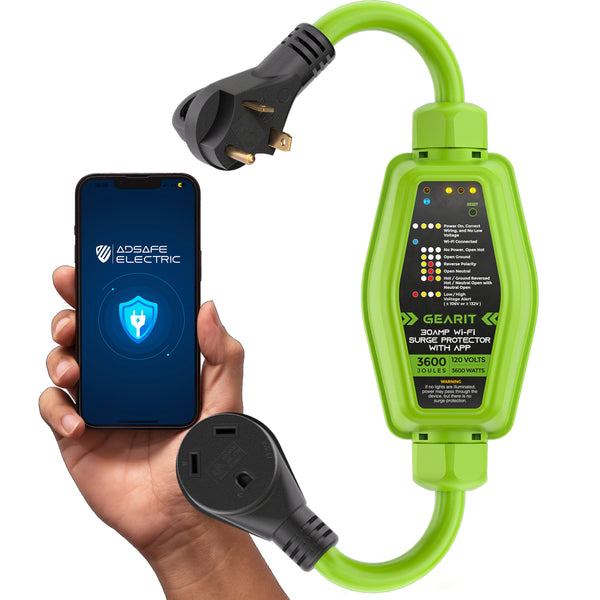
- Smart monitoring: Wi‑Fi–enabled protectors display real‑time volts/amps/watts on your phone. They’re helpful for visibility and planning loads; depending on model, they may not replace a true EMS cutoff.
30A vs 50A: which protector should you buy?
Match the protector to the service your RV is built for. Adapters (“dogbones”) don’t change what your RV can safely draw. If you use adapters often, review safe combinations in Adapters and Dogbones: Safe Combinations and What to Avoid.
Use this compact decision matrix to choose confidently.
| Option | Use with | What it protects | Pros | Tradeoffs |
|---|---|---|---|---|
| 30A Surge Protector | 30A TT‑30 RVs | Voltage spikes; basic wiring faults (indicator) | Affordable; simple plug‑in; travel‑friendly | Usually no automatic cutoff for sustained faults |
| 50A Surge Protector | 50A 14‑50 RVs | Voltage spikes across both legs; basic wiring faults | Handles higher capacity rigs with multiple A/Cs | Larger; costs more than 30A units |
| 30A/50A Wi‑Fi Surge Protector | 30A or 50A rigs | Spikes + live monitoring of volts/amps/watts | See loads in real time; helpful for load planning | Monitoring isn’t the same as EMS shutoff |
| 30A/50A EMS | 30A or 50A rigs | Spikes and sustained faults with automatic shutoff | Broadest protection for suspect power | Higher price; slightly larger footprint |
Feature checklist: what to look for
- Correct amperage: 30A for TT‑30 inlets; 50A for 14‑50 inlets.
- Joule rating: Higher joules generally mean more surge absorption (useful in storm‑prone regions like the Southeast and Midwest).
- Diagnostics: LED indicators that call out open ground, reverse polarity, open neutral, and low voltage before you energize your rig.
- Weather protection: Outdoor‑rated construction, covers, and strain relief for year‑round use from coastal humidity to mountain cold.
- Smart monitoring (optional): Real‑time volts/amps/watts help you avoid tripping pedestals and manage A/C cycles during summer heat in states like Texas, Arizona, and Florida.
- EMS capability (optional): Automatic cutoff adds peace of mind at older campgrounds or during rolling brownouts.
Real‑world scenarios and recommendations
- Older state parks in the Southeast or Northeast: Power can sag on hot afternoons. If you depend on A/C, step up to EMS‑level protection or a unit with low‑voltage alerts so you can shed loads.
- Summer in the Sun Belt (AZ, TX, FL): Two A/Cs and a convection microwave on a 50A rig point to a 50A protector; smart monitoring helps you keep both legs balanced.
- Storm‑prone Plains and Midwest: Higher‑joule protection is a smart hedge against lightning‑related surges.
- Boondocking with a portable generator: Use a protector at the generator end and mind cord length and gauge to limit voltage drop. If you need a short, safe generator lead for 30A gear, see the 30 Amp 10/3 AWG TT‑30P to L5‑30R generator power cord, then plug your RV’s protector in after the cord.
If you regularly extend beyond standard cord lengths, use the sizing tips in Voltage Drop Calculator: Picking the Right Gauge by Length (30A/50A) and, for cold‑weather flexibility, see 50A RV Cords: Copper Gauge, Jacket Type, and Cold‑Weather Flex.
Setup and safety: before you plug in
- Inspect the pedestal for heat damage, scorch marks, or loose outlets. Run the checks in Campground Hookups Checklist: Before You Plug In.
- Test first. Many protectors show wiring status (open ground, reverse polarity) before you energize your RV.
- Avoid unsafe adapter chains. Review safe pairings in Adapters and Dogbones: Safe Combinations and What to Avoid.
- Monitor voltage under load—especially when A/C starts. Smart protectors that show volts/amps help you catch sags early.
GEARit options to consider
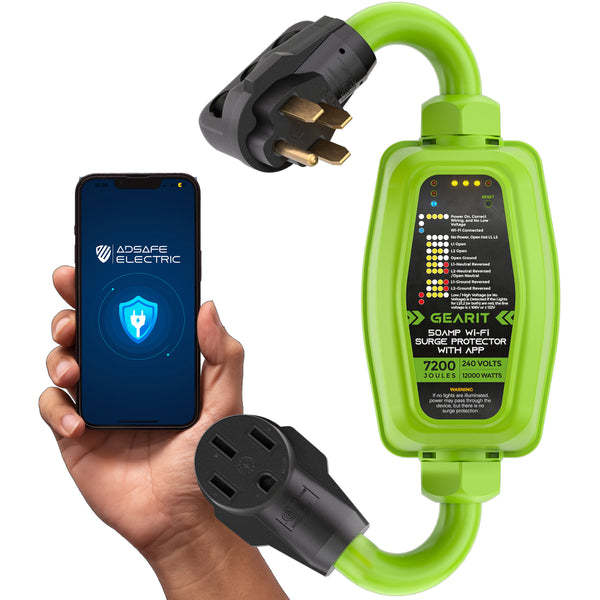
- 50A smart monitoring with high surge capacity: If your Class A or large fifth‑wheel runs two A/Cs, a 50A smart unit with high joules offers visibility and headroom. See the 50 Amp WiFi RV Surge Protector - Monitor in Real Time (up to 7200J) for live volts/amps/watts and wiring diagnostics.
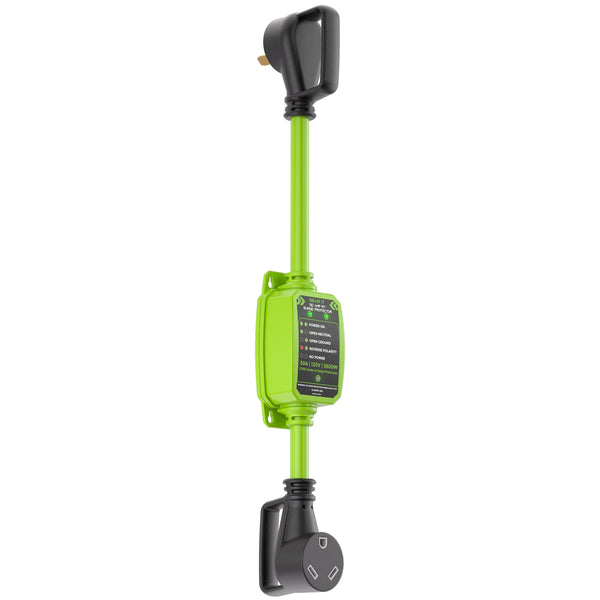
- 30A smart monitoring for travel trailers: For single‑A/C 30A rigs, the 30 Amp WiFi RV Surge Protector - Monitor in Real Time (up to 3600J) helps you balance loads, spot sags, and verify pedestal wiring.
- 50A weather‑resistant plug‑style protection: Prefer a straightforward, durable plug‑in without app monitoring? The 50 Amp Heavy Duty Weather Resistant RV Surge Protector is a compact option with robust surge absorption and diagnostic LEDs.
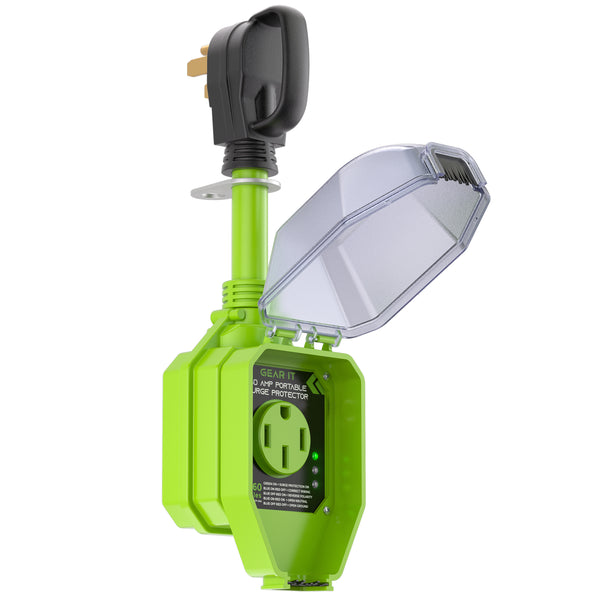
- 50A plug with cover and reset: For frequent rain or coastal humidity, a covered plug can help keep connections protected. See the 50-Amp RV Surge Protector Plug with Weatherproof Cover and OCP Reset for a simple, budget‑friendly approach.
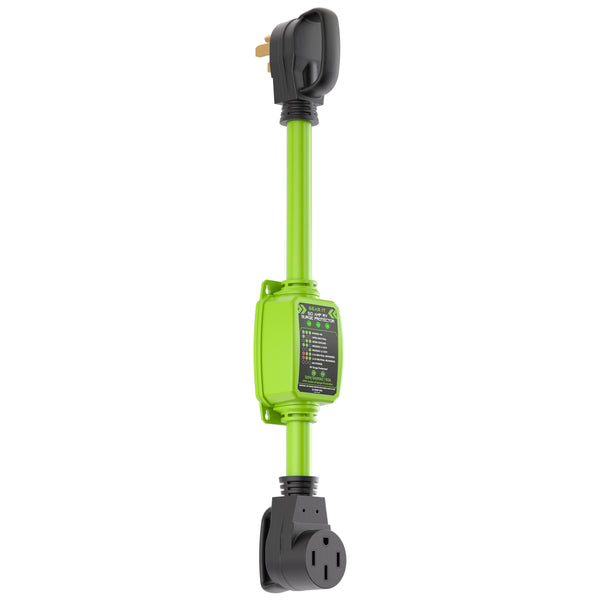
- 30A plug‑style protection: If you want basic protection in a compact form factor, the 30-Amp RV Surge Protector Plug is easy to stash and quick to deploy for weekend trips.
New to 50A cords or carrying a spare? This overview on 50A RV cords, gauge, and jackets can help you choose the right cable for your route and climate.
Frequently Asked Questions
Can I use a 50A protector on a 30A RV (or vice versa)?
No. Match the protector to your RV’s service (30A or 50A). Adapters don’t change the RV’s internal rating, and a mismatched protector can misread or fail to protect properly. See TT‑30 vs 14‑50 for details.
Do I really need EMS if I already have surge protection?
Surge protection handles momentary spikes. EMS adds ongoing monitoring with automatic disconnect for sustained low/high voltage or miswiring. If you camp in older parks, hot‑weather peak seasons, or regions with frequent storms, EMS is a strong upgrade.
Where should I place the surge protector?
Plug it directly into the pedestal first, then connect your cord to the protector. This keeps the pedestal side protected and lets you read diagnostics before energizing your RV.
What about generators?
Use your protector between the generator and RV as well. Keep cords short and appropriately gauged to minimize voltage drop; when you need a short adapter lead for 30A setups, consider the 30 Amp TT‑30P to L5‑30R generator cord. For more on generator cord types and reach, see Generator Cords: L14‑30 and L5‑30—What They Power and How Far.
Next steps
If you’re still deciding, walk through the Campground Hookups Checklist, then review adapter safety in Adapters and Dogbones. For power planning by length and climate, explore the Voltage Drop Calculator and our note on STW vs SJTW jackets, IP ratings, and storage. When you know your service (30A or 50A) and protection level (surge vs EMS), choosing the right unit becomes straightforward and stress‑free.