

RV Power Basics: TT‑30 vs 14‑50 Explained with Use Cases
Sorting out TT‑30 versus 14‑50 is one of the first power questions most RV owners face. This guide explains what each connector delivers, how much equipment you can run on it, and when a quality adapter, splitter, or extension cord makes sense for typical U.S. and Canada campgrounds.
TT‑30 and 14‑50 in plain English
TT‑30 (30A) is a 120‑volt, 3‑wire plug designed for RVs. It has one hot blade, one neutral, and a ground, supplying up to 30 amps at 120V (about 3,600 watts). You’ll find it widely across U.S. and Canada campgrounds, especially at sites built for travel trailers and smaller motorhomes.
14‑50 (50A) is a 120/240‑volt, 4‑wire receptacle with two hot legs, a neutral, and a ground. In RV applications it provides two separate 120V, 50A legs—up to about 12,000 watts total capacity. It’s common at full‑hookup sites that support larger fifth‑wheels and Class A coaches and also appears at many U.S. residential garages for EV charging.
Quick comparison: Which service fits your setup?
Use this table to match your rig and power needs:
| Connector | Voltage / Poles | Max Current | Typical Capacity | Best For |
|---|---|---|---|---|
| TT‑30 (NEMA TT‑30) | 120V, 1 hot + neutral + ground | 30A | ≈ 3,600W | Travel trailers, smaller Class C rigs, one A/C plus light loads |
| 14‑50 (NEMA 14‑50) | 120/240V split‑phase, 2 hots + neutral + ground | 50A per leg (two 120V legs) | Up to ≈ 12,000W | Large fifth‑wheels/Class A coaches, dual A/Cs, residential 14‑50 outlets |
How to choose: Real‑world use cases
If your rig ships with a 30A inlet
- Campground stays on 30A pedestals: A dedicated 30A extension keeps voltage steadier over distance. A durable option is the 30‑Amp NEMA TT‑30 extension cord, sized for 30A loads and outdoor use.
- Occasional sites with only 50A available: Use a 50A‑to‑30A adapter at the pedestal so your RV still sees 120V/30A. See safe practices in Adapters and Dogbones: Safe Combinations and What to Avoid.
If your rig ships with a 50A inlet
- Full‑hookup resorts and hot climates: A 50A service lets you run multiple A/Cs, microwave, and more simultaneously. For added reach between the pedestal and your coach, consider a heavy‑duty 50‑Amp NEMA 14‑50 extension cord.
- When a pedestal only offers 30A: You can power a 50A coach from a 30A source with a proper adapter, but your total available power drops to ≈3,600W, so shed loads (run one A/C at a time). The load‑planning tips in Campground Hookups Checklist: Before You Plug In help avoid trips back to the breaker.
Cable length, gauge, and voltage drop
Longer cords increase resistance and voltage drop, which can cause dim lights, hot plugs, or A/C compressor strain. Keep runs as short as practical and use adequately thick conductors: 10 AWG for 30A TT‑30 runs and 6/3 + 8/1 AWG for many 50A 14‑50 cords. For planning longer distances, use the Voltage Drop Calculator: Picking the Right Gauge by Length (30A/50A) to pick the right length and gauge before you buy.
Adapters and splitters: What’s sensible, what’s not
Adapters and “dogbones” are useful for matching what your RV needs to what a pedestal or generator provides—but they don’t increase available power. Keep total draw within the source rating and your weakest connector or cord.
- Share a 50A pedestal with two 30A rigs: A splitter such as the 50‑Amp 14‑50P to dual TT‑30R splitter can feed two 30A RVs from one 50A source. Each RV still must respect 30A, and the combined draw must not exceed the pedestal limits. For adapter do’s and don’ts, see Adapters and Dogbones: Safe Combinations and What to Avoid.
- Duplicate outlets from one 30A source: A compact Y‑cable like the TT‑30P to dual TT‑30R splitter provides two receptacles for convenience (for example, a trailer plus a small 30A‑rated accessory), but the total load is still limited to 30A. Monitor usage and avoid running high‑draw appliances at the same time.
- Mixing plug types: Before combining adapters, confirm grounding and pinout are correct. Review practical checks in Campground Hookups Checklist: Before You Plug In.
Generator and shore interfaces you may encounter
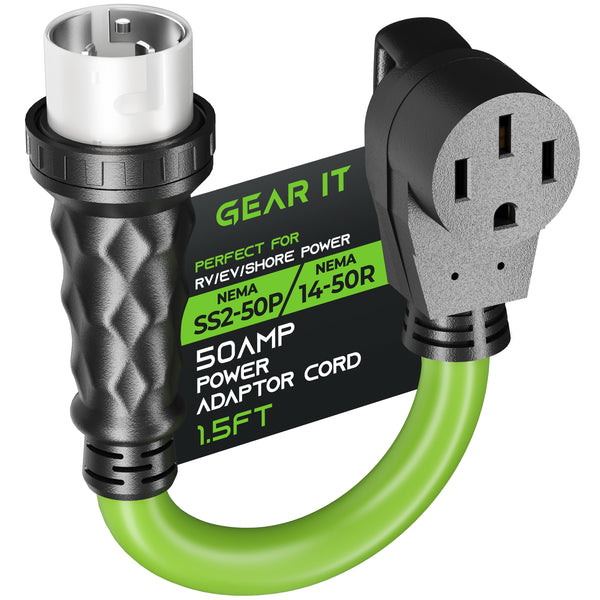
Many 50A RV shore cords end in a twist‑lock (SS2‑50). If your site or generator offers a 14‑50 receptacle, you can bridge the connection with a purpose‑built cord like the 14‑50P to SS2‑50R twist‑lock connector cord. Conversely, when a dock or pedestal provides SS2‑50 and your RV cord expects 14‑50, use a short adapter such as the SS2‑50P to 14‑50R shore power adapter to keep the transition compact and secure.
If you rely on a portable generator with L14‑30 or L5‑30 outlets, see Generator Cords: L14‑30 and L5‑30—What They Power and How Far for outlet types, run length, and load planning.
Protection and outdoor durability
Campground power quality varies. A surge protector or EMS helps detect miswired pedestals and voltage issues before they reach your RV. Start with the guidance in Surge Protection for RVs: 30A vs 50A and When You Need EMS, then add pre‑plug checks from Campground Hookups Checklist: Before You Plug In.
For cord jackets, STW handles outdoor abrasion and temperature swings well. Learn how jacket type, storage, and care affect lifespan in Outdoor Use: STW vs SJTW Jackets, IP Ratings, and Storage and, for cold‑weather specifics, 50A RV Cords: Copper Gauge, Jacket Type, and Cold‑Weather Flex.
Special scenarios
- Home 14‑50 outlet for an RV or EV: A 14‑50 can power a 50A RV or a portable EVSE. If you’re sharing with an EV, review safe cord choices in EV Portable Charging with 14‑50 Outlets: Cable Considerations.
- Temporary power distribution: Need 14‑30 and 14‑50 from a single dryer‑style outlet during maintenance days? A selective splitter like the 14‑30P to 14‑30R and 14‑50R splitter can simplify setups in workshops; always observe circuit limits and local codes.
Troubleshooting tips
- Breaker trips when A/C starts: You’re likely at or near the limit on a 30A service. Shed loads (water heater, microwave) or move to a 50A site. See step‑by‑step checks in Troubleshooting Tripped Breakers and Hot Plugs.
- Warm connectors: Unplug and inspect for bent blades, loose fits, or damaged jackets. Excessive heat often points to undersized wire for the length or poor contact pressure. If you routinely need extra reach on 50A sites, a short, heavy‑gauge 14‑50 extension cord can reduce stress at connection points compared with daisy‑chained adapters.
Frequently Asked Questions
Can I plug a 30A RV into a 50A pedestal?
Yes—with a proper 50A‑to‑30A adapter. Your RV will still be limited to 30A at 120V (≈3,600W). Use a dedicated 30A extension like the TT‑30 extension cord to minimize voltage drop on longer runs and keep the adapter at the pedestal, not at the RV inlet.
Does a 50A (14‑50) hookup give my RV 240 volts?
Most RVs distribute power as two separate 120V legs from the 14‑50 connection. Unless your RV specifically has a 240V appliance, onboard loads remain 120V. Balancing loads across the two legs helps avoid nuisance trips.
What cord length should I buy?
Buy the shortest length that reaches comfortably with a little slack at typical campsites. Longer cords increase voltage drop—use thicker conductors for long runs. Plan with the Voltage Drop Calculator.
How do I connect a 50A RV to a twist‑lock shore post?
Use a short interface that preserves a secure connection, such as the 14‑50P to SS2‑50R twist‑lock connector cord or, when the pedestal is SS2‑50 only, the compact SS2‑50P to 14‑50R adapter.
Next steps
If you’re 90% sure which service you need but want to sanity‑check cord gauge and outdoor durability, skim Outdoor Use: STW vs SJTW Jackets, IP Ratings, and Storage and the sizing guidance in 50A RV Cords: Copper Gauge, Jacket Type, and Cold‑Weather Flex. Before your next trip, run through the quick safety steps in Campground Hookups Checklist: Before You Plug In.