

Generator Cords: L14‑30 and L5‑30—What They Power and How Far
If you’re pairing a portable generator with a home transfer switch, food truck, worksite tool, or RV, you’ll run into two common 30‑amp connectors: L14‑30 and L5‑30. This guide explains what each one powers on typical U.S. 120/240V systems, how far you can safely run a cord before voltage drop becomes a problem, and how to choose gauge, jacket, and adapters with confidence.
Quick definitions
- L14‑30 (120/240V, 4‑wire, twist‑lock): Two hot legs, one neutral, one ground. Feeds split‑phase 120/240V loads—great for home transfer switches and small panel inlets.
- L5‑30 (120V, 3‑wire, twist‑lock): One hot, one neutral, one ground. Feeds a single 120V, 30A circuit—common on RVs, food trucks, and portable equipment with a 30A 120V inlet.
What an L14‑30 cord powers
An L14‑30 cord carries both 120V legs plus neutral and ground, so it can supply 240V loads or two balanced 120V legs through a transfer switch. Typical uses include:
- Home backup via a 120/240V transfer switch or inlet box.
- Jobsite gear that needs 240V (e.g., some compressors) or split 120V circuits.
- Temporary panels and power distribution boxes with multiple 120V outlets.
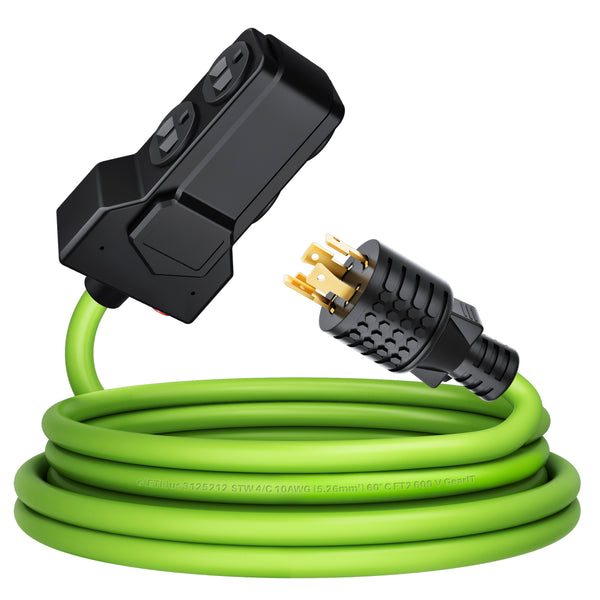
If you want a durable, color‑visible option for connecting a 30A generator to a transfer switch, consider the 30 Amp NEMA L14‑30 Generator Extension Power Cord. It’s a fit when you need a locking 120/240V connection and plan to balance loads across both legs.
What an L5‑30 cord powers
An L5‑30 cord supplies a single 120V, 30A circuit. It’s common when you don’t need 240V:
- RV and camper 30A service through a 120V shore cord or adapter.
- Food trucks and concessions that are wired for a single 120V, 30A inlet.
- Portable lighting, heaters, or tools that specify a 120V/30A feed.
If your campsite pedestal has a TT‑30 (standard 30A RV) outlet and your equipment expects L5‑30, a safe bridge is an adapter like the 30 Amp NEMA TT‑30P to L5‑30R Adapter. Use it when your load is strictly 120V and within 30A.
L14‑30 vs L5‑30 at a glance
Use this quick matrix to match the connector to your job.
| Connector | Voltage / Poles | Typical Use | Pros | Watch‑outs |
|---|---|---|---|---|
| L14‑30 | 120/240V split‑phase, 4‑wire | Home transfer switches, 240V tools, small panels | Feeds 240V and dual 120V; supports balanced loads | Requires matching 120/240V generator; heavier 4‑conductor cable |
| L5‑30 | 120V single‑phase, 3‑wire | RVs (30A), food trucks, 120V equipment | Simpler single‑circuit power; lighter 3‑conductor cable | No 240V capability; one 120V leg only |
How far can you run a 30A generator cord?
Distance is limited by voltage drop and the cord’s gauge. For U.S. 120V loads, aim to keep voltage drop near or below 3–5% under typical load. Practical guidance with 10 AWG copper STW cords:
- High 120V loads (20–30A continuous): Keep 25–50 ft when possible for best performance. Longer runs increase heat and reduce tool/appliance efficiency.
- Moderate 120V loads (10–20A): 50–75 ft is workable with 10 AWG; monitor for warm plugs or dimming lights under startup surges.
- Split‑phase L14‑30 at mixed loads: Balance the 120V legs to reduce drop on either leg, and keep total length (generator to inlet to sub‑runs) as short as the site allows.
For project‑specific planning, use the Voltage Drop Calculator: Picking the Right Gauge by Length (30A/50A) to estimate the right gauge and length before you buy.
Choosing gauge, jacket, and outlet style
Gauge and conductor count
- 10/3 (hot, neutral, ground): For 120V, 30A L5‑30 or TT‑30 circuits. Example: a 30A RV hookup or 120V food‑truck feed.
- 10/4 (two hots, neutral, ground): For 120/240V L14‑30. Needed for home transfer switches and any 240V‑capable run.
Jacket and environment
- STW jackets handle outdoor use and colder temps with good flexibility. For material and weather details, see Outdoor Use: STW vs SJTW Jackets, IP Ratings, and Storage.
Outlet style (distribution needs)
- Single‑receptacle pass‑through: Best when you’re feeding a single inlet, such as a transfer switch or RV.
- Splitters or outlet boxes: Useful if you must power multiple 120V tools from an L14‑30 source. A compact option is the 30 Amp 14‑30P to 4× 5‑20R Distribution Cord, which integrates standard 20A outlets with overload protection.
Real‑world pairings (and why they fit)
- Home backup with transfer switch (120/240V): Choose a locking L14‑30 cord to keep the plug secure under load and weather. The 30 Amp NEMA L14‑30 Generator Extension Power Cord matches 30A 120/240V generators and inlet boxes.
- RV with 30A service (120V only): TT‑30 is the native RV standard. If your run is just RV‑to‑pedestal, use a TT‑30 cord like the 30‑Amp TT‑30P to TT‑30R RV Cord. If your generator or distribution requires L5‑30, bridge it with the TT‑30P to L5‑30R Adapter.
- Food truck or concession (120V, 30A): An L5‑30 cord provides a secure twist‑lock on a single 120V circuit. Keep runs as short as layout allows to minimize drop when fryers or refrigerators cycle.
- Temporary 120V distribution from a 30A generator: If your generator has L14‑30 output but your tools are 120V, a distribution cord such as the 30 Amp 14‑30P to 4× 5‑20R Extension can simplify branching while protecting outlets from accidental unplugging.
- Stepping up to 50A equipment: When the load or distance grows and your source and inlet are 50A, move to a 6/3+8/1 50A cord. Examples include the heavy‑duty 50 Amp 14‑50P to SS2‑50R Twist‑Lock Cord for inlets and the bright‑jacket 50 Amp 14‑50 Extension Cord (Green) for visibility on site.
Safe adapter use (and what to avoid)
Adapters are handy, but they don’t change what your generator or cord can safely deliver.
- Match voltage: Don’t “adapt” a 240V L14‑30 source to a device that only accepts 120V unless the adapter or panel provides proper 120V distribution and overload protection.
- Respect the lowest rating in the chain: A 30A adapter feeding a 20A receptacle limits you to 20A on that branch.
- Skip daisy‑chains: Each extra adapter adds resistance and points of failure. Choose one quality adapter that gets you to the exact outlet you need. For a deeper primer, see Adapters and Dogbones: Safe Combinations and What to Avoid.
Planning for RV pedestals and campground rules
Campground power varies, especially across U.S. state parks and private parks. Review on‑site rules and verify which outlets (TT‑30, 14‑50, or 5‑20) are present. For a quick field checklist, use Campground Hookups Checklist: Before You Plug In, and if you’re deciding between 30A and 50A rigs, skim RV Power Basics: TT‑30 vs 14‑50 Explained with Use Cases.
Setup tips that prevent hot plugs and nuisance trips
- Fully seat twist‑locks: Insert, twist until it stops, then tug lightly to confirm lock.
- Uncoil the cord: Coiled cable traps heat under load. Lay it out in loose S‑curves.
- Keep connections dry and elevated: Use covers or drip loops; never let a connection sit in water. For storage and weather care, see Outdoor Use: STW vs SJTW Jackets, IP Ratings, and Storage.
- Balance L14‑30 legs: On transfer switches, spread 120V loads across both legs to reduce nuisance breaker trips and keep voltages even.
- Add protection for RVs: Many travelers use a surge protector or EMS at the pedestal; start with Surge Protection for RVs: 30A vs 50A and When You Need EMS.
Frequently Asked Questions
Is L14‑30 the same as 30A RV power?
No. L14‑30 is 120/240V split‑phase (four wires). Standard RV 30A service is TT‑30 at 120V (three wires). If you need to go from a TT‑30 pedestal to equipment with an L5‑30 inlet, use a purpose‑built adapter like the TT‑30P to L5‑30R Adapter.
How long can my 30A cord be without issues?
Shorter is better. With 10 AWG copper, try to stay within 25–50 ft for heavy 120V loads and 50–75 ft for moderate loads. For precise planning by load and distance, consult the Voltage Drop Calculator.
Can I power multiple 120V tools from an L14‑30 source?
Yes—if you use a distribution solution made for that purpose. A 10/4 L14‑30 to multi‑outlet cord such as the 30 Amp 14‑30P to 4× 5‑20R Distribution Cord provides standard receptacles and integrated protection.
When should I move from 30A to 50A cords?
Move up when your connected load exceeds 24A continuous at 120V, you need 240V at higher current, or you’re losing too much voltage over distance. If your inlet and source are 50A, choose a 6/3+8/1 cord such as the 50 Amp 14‑50P to SS2‑50R Twist‑Lock Cord.
Next steps
If you’re powering a home transfer switch, start with an L14‑30 cord in the shortest length that reaches cleanly. RV or food‑truck users focused on 120V can stick with L5‑30 or TT‑30 as appropriate. For distance and load planning, plug your numbers into the Voltage Drop Calculator, and if your site is exposed to weather or cold, review jacket and storage tips in Outdoor Use: STW vs SJTW Jackets, IP Ratings, and Storage. If breakers are tripping or plugs feel warm, work through Troubleshooting Tripped Breakers and Hot Plugs before your next run.