

Voltage Drop Calculator: Picking the Right Gauge by Length (30A/50A)
If your RV A/C struggles, your EVSE charges slowly, or your generator labors under load, voltage drop is often the quiet culprit. This guide shows you exactly how far you can run 30A and 50A cables before stepping up gauge, using simple math, quick-reference tables, and U.S.‑standard connectors (TT‑30 and 14‑50). It’s written for real‑world use at American campgrounds, job sites, marinas, and homes.
What is voltage drop and why it matters
All wire has resistance. As current flows, you lose voltage across the wire. Too much drop can overheat plugs, trip breakers, dim lights, make motors run hot, and reduce charger output. For planning portable cords and temporary feeders, many pros aim for about 3% drop; up to 5% may be acceptable for short, non‑critical runs. Lower drop is always kinder to equipment.
Quick voltage drop calculator (works for copper)
Use this one‑line formula to estimate drop for any copper cord:
- Percent drop (%) = (2 × one‑way length (ft) × resistance (Ω per 1000 ft) × current (A)) ÷ (1000 × supply voltage (V)) × 100
Lookup resistances for common copper AWG: 10 AWG ≈ 0.999 Ω/1000 ft, 8 AWG ≈ 0.628 Ω/1000 ft, 6 AWG ≈ 0.395 Ω/1000 ft, 4 AWG ≈ 0.249 Ω/1000 ft. Double the one‑way length because current travels out and back.
30A at 120V (TT‑30): how far each gauge can go
These limits keep total drop near the target shown. They assume copper conductors in good condition, typical ambient temperatures, and a continuous 30A load at 120V.
| Gauge (AWG) | Max one‑way length for ≈3% drop | Max one‑way length for ≈5% drop | Typical use |
|---|---|---|---|
| 10 AWG | ≈60 ft | ≈100 ft | Common 30A RV/generator cords (short to medium runs) |
| 8 AWG | ≈95 ft | ≈160 ft | Longer 30A runs or hot climates |
| 6 AWG | ≈150 ft | ≈250 ft | Extra‑long 30A feeds with minimal drop |
Example: A 50 ft one‑way 30A run on 10 AWG copper drops about 2.5%—a solid choice for many RV sites.
For U.S. RV context and connector differences, see RV Power Basics: TT‑30 vs 14‑50 Explained with Use Cases.
50A at 120/240V (14‑50 or SS2‑50): planning by length
A 50A service supplies two 120V legs from a 240V split‑phase source. Extension cords are usually sized by the full 50A rating; most 50A RV cords use heavy copper (often 6 AWG for the hot conductors). The table below uses a 240V reference for percentage—helpful for feeders—and yields conservative results for typical RV loads distributed across the two 120V legs.
| Gauge (AWG) | Max one‑way length for ≈3% drop | Max one‑way length for ≈5% drop | Typical use |
|---|---|---|---|
| 8 AWG | ≈115 ft | ≈190 ft | Moderate‑length 50A runs |
| 6 AWG | ≈180 ft | ≈305 ft | Standard heavy‑duty 50A RV/shore cords |
| 4 AWG | ≈290 ft | ≈480 ft | Very long feeders, minimal drop |
Practically, most U.S. RVers stick to 25–50 ft of 50A cord because weight and coil size increase quickly. If you need more reach, choose heavier gauge rather than chaining adapters.
For connector types and reach planning on generator outputs, see Generator Cords: L14‑30 and L5‑30—What They Power and How Far.
Step‑by‑step: pick gauge by length in under a minute
- Identify the service: 30A at 120V (TT‑30) or 50A split‑phase (14‑50/SS2‑50).
- Measure one‑way distance: Pedestal to inlet. Don’t forget slack for safe routing.
- Choose a target drop: Aim for ~3% when running A/C compressors, inverter‑chargers, or sensitive electronics; up to 5% can be fine for short, temporary loads.
- Use the table above: Match your current and find the longest one‑way length that stays at or under your target drop. If you’re in a hotter climate or bundling cords, move one row heavier.
- Prefer one stout cord over daisy‑chains: Each extra connection adds resistance and heat. If you must adapt, keep adapters short and heavy‑gauge.
Real‑world examples
- 30A RV site, 35 ft to pedestal: 10 AWG copper keeps drop under ~2%. A rugged 10/3 STW TT‑30 extension is a good match; see 30‑Amp TT‑30P to TT‑30R Extension Cord.
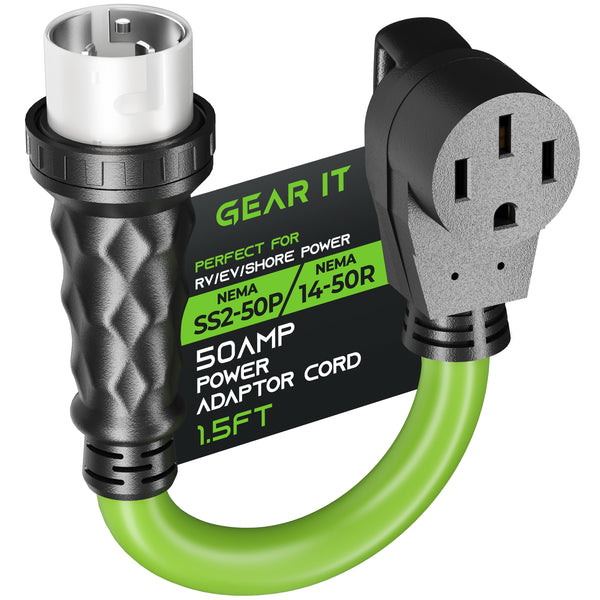
- 50A fifth‑wheel, 45 ft to shore power: Standard 6 AWG 50A cord stays well under 3% and handles startup surges gracefully. If you’re adapting from a twist‑lock pedestal to a straight‑blade inlet, keep the adapter short, like this SS2‑50P to 14‑50R 50A shore power adapter (1.5 ft).
- 30A portable generator to RV (L5‑30 outlet to TT‑30 inlet): Use a purpose‑built 10/3 copper cord to minimize drop and avoid warm blades. An L5‑30 to TT‑30 adapter cord like 30‑Amp TT‑30P to L5‑30R Generator Power Cord keeps the run simple and safe.
Before you plug in at a new site, walk through this short Campground Hookups Checklist to spot pedestal issues early.
Key buying factors beyond gauge
Jacket type and weather
- STW vs SJTW: STW jackets are thicker and built for heavy outdoor duty. If you set up in rain, sun, or snow, start with STW. For a deeper explanation, see Outdoor Use: STW vs SJTW Jackets, IP Ratings, and Storage.
- Cold‑weather handling: Thick copper stays flexible in quality jackets, but big 50A cords can get stiff below freezing. See 50A RV Cords: Copper Gauge, Jacket Type, and Cold‑Weather Flex.
Adapters ("dogbones")
- Use short, heavy‑gauge adapters: They add resistance; keep them minimal length to limit drop and heat. Review safe combinations in Adapters and Dogbones: Safe Combinations and What to Avoid.
Protection and heat checks
- Feel for warmth at connectors: Warm is common under load; hot to the touch indicates resistance—reduce length, increase gauge, or replace worn parts. If breakers nuisance‑trip, walk through Troubleshooting Tripped Breakers and Hot Plugs.
- Surge and EMS: To protect onboard electronics at unfamiliar pedestals, see Surge Protection for RVs: 30A vs 50A and When You Need EMS.
Special cases: EV portable charging and solar
Many U.S. EV drivers use 14‑50 outlets. Keep the extension short and heavy—use 6 AWG for 50A‑rated runs, and favor a short adapter at the pedestal rather than extra cord length; see EV Portable Charging with 14‑50 Outlets: Cable Considerations. For off‑grid or boondocking solar, DC voltage is lower so drop matters even more; stepping up to 10 or 12 AWG on panel leads helps keep charge controllers happy. Purpose‑built solar extensions like 10AWG Solar Panel Extension Cable are a simple upgrade.
Planning tips for U.S. campgrounds and homes
- Pick the shortest layout that reaches cleanly: Avoid tight coils under load; they trap heat.
- Route off the ground where practical: Reduces trip hazards and water exposure.
- Go up one gauge for high heat, long duty cycles, or frequent adapter use: Copper mass and lower resistance buy margin.
- Store clean and dry: Extends jacket life. For seasonal storage, see Winterizing Your Power Gear: Inspection and Care.
Recommended GEARit options for common runs
- 30A RV extension, 25–50 ft: A 10/3 copper TT‑30 cord balances flexibility and low drop. See 30‑Amp TT‑30P to TT‑30R Extension Cord.
- Portable generator to RV (L5‑30 to TT‑30): Keep it simple with a single heavy‑duty adapter cord like 30‑Amp TT‑30P to L5‑30R Generator Power Cord.
- Shore pedestal to 14‑50 EVSE/RV inlet: Minimize added length with a short adapter such as SS2‑50P to 14‑50R 50A Shore Power Adapter (1.5 ft).
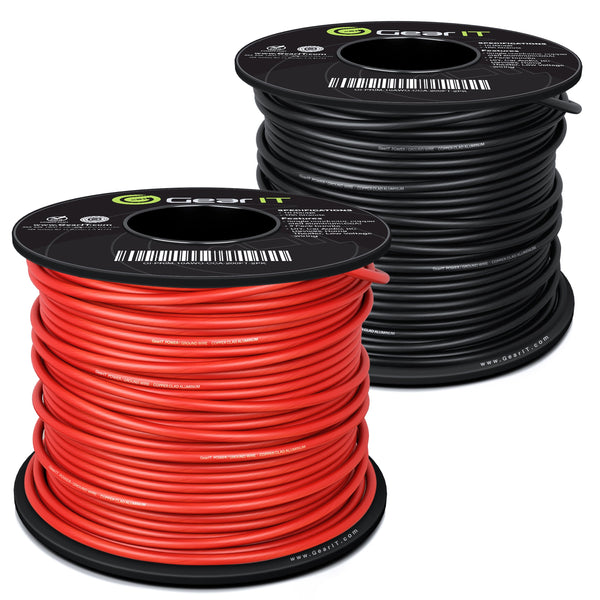
- 12V inverters and auxiliary batteries: Keep DC drop low with ample copper. For short, high‑current leads, consider 4‑gauge automotive primary wire; for lighter runs, 8‑gauge automotive primary wire is a practical step‑up from 10 or 12 AWG.
Frequently Asked Questions
Is 10 AWG enough for a 30A RV cord at 50 ft?
Yes—on a 30A, 120V circuit, 10 AWG copper at 50 ft one‑way is roughly 2.5% drop. If you’re stacking adapters, in high heat, or frequently maxing out the 30A, consider 8 AWG for extra margin.
How far can I run 50A before I should move from 6 AWG to 4 AWG?
With 50A split‑phase service, 6 AWG copper keeps you near 3% drop until about 180 ft one‑way. Beyond that—or if you want even lower drop—4 AWG provides headroom, at the cost of weight and stiffness.
Do coiled cords run hotter?
They can. Coils trap heat and make it harder to feel developing hot spots. Lay cords out straight and off the ground when possible, especially under heavy loads like A/C or EV charging.
Is aluminum wire OK for portable 30A/50A cords?
Portable RV, generator, and shore‑power cords are typically copper for flexibility and lower resistance. Aluminum requires upsizing and is uncommon in flexible cords—stick with copper for portable runs.
Next steps
If you know your connector type, distance, and current, you’re ready to pick a gauge using the tables above. For connector choices, protection, and site checks, these quick reads help you finish the plan: RV Power Basics: TT‑30 vs 14‑50, Adapters and Dogbones, and Campground Hookups Checklist. If you’re powering from a generator, start here: Generator Cords: L14‑30 and L5‑30.