

Wired beats Wi‑Fi for stable latency and fewer spikes. This guide helps you pick the right Ethernet cable, plan the route, and configure your gear so your ping stays consistent—without paying for specs you won’t use. GEARit focuses on dependable, pre‑terminated cables so you can plug in and play fast.
Quick answers for gamers
- Do you need 10G? Many U.S. home internet plans fall between 300 Mbps and 1 Gbps, and a growing number of routers and NICs support 2.5G. For typical PC and console play, a quality Cat6 patch cord is usually the right fit. If you’re weighing 1G vs 2.5G vs 10G, see Cat6 vs Cat6a vs Cat8: Pick the Right Cable for 1G, 2.5G, 5G, and 10G.
- How long can a cable be? Keep the total channel under 100 meters (about 328 ft) end‑to‑end, including patch cords. For planning tips and corner cases, see Patch Cable Length Limits and When You Need a Booster or Longer Run Strategy.
- Shielding: yes or no? Use shielded cable for outdoor routes and near high‑EMI areas (parallel to AC power, near ballasts). Use unshielded indoors for ordinary home paths to save money and keep flexibility. Learn more in Shielded vs Unshielded (S/FTP vs UTP): How to Reduce Interference at Home.
Choose the right cable—performance without overbuying
For PC and console gaming, three cable types cover almost every home scenario. Pick based on speed support, environment, and routing constraints.
Indoor patch from router to PC/console
For short indoor runs (3–25 ft) to a gaming PC, PlayStation, Xbox, or Switch dock, a stranded, snagless Cat6 patch cord balances reliability, flexibility, and cost. It supports gigabit and commonly negotiates 2.5G on compatible hardware. If you want stable latency and a durable cord for frequent moves, a pure‑copper build is a smart bet—try a Cat6 snagless patch cable. For bright setups or easier labeling, a high‑visibility option like the Cat6 snagless patch cable (white) works well.
Flat, low‑profile runs along baseboards or under rugs
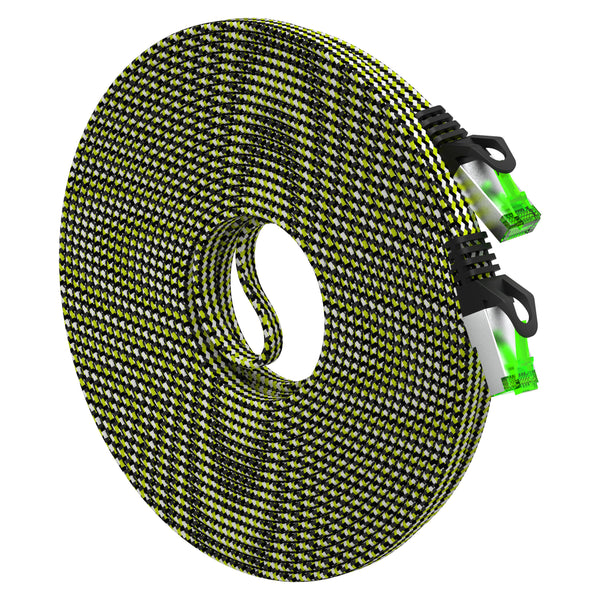
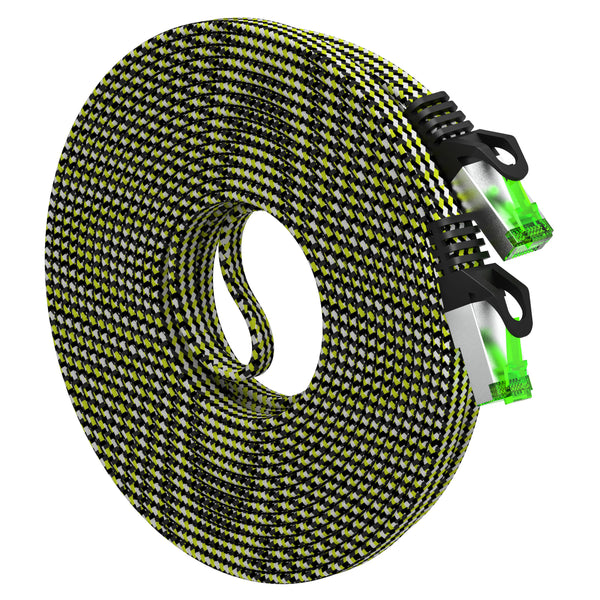
When you need the cable to disappear under a rug or trace a doorway, a thin, shielded flat cable reduces tripping hazards and helps in RF‑noisy apartments. Keep routing smooth and avoid pinch points under furniture. For wall‑hugging or under‑carpet paths, consider a Cat7 flat patch cable (25 ft). If a single continuous low‑profile run solves the route, the Cat7 flat patch cable (33 ft) keeps things tidy. For bend‑radius trade‑offs and placement tips, see Flat vs Round Ethernet: Bend Radius, Under‑Carpet Runs, and Trade‑offs.
Outdoor or garage/ADU to house
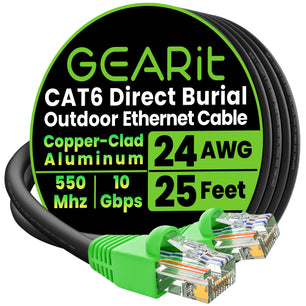
Running Ethernet between buildings or into a detached space? Choose a UV‑resistant, water‑blocked cable rated for direct burial or conduit. Shielding helps reject interference from outdoor electrical runs. For this use, a 23AWG shielded Cat6 outdoor cable is built for harsh weather. For budget installs where PoE isn’t needed and distances are modest, a Cat6 outdoor CCA cable can work for simpler runs. For weatherproofing steps like drip loops and sealing, read Weather, Water, and Conduit: Best Practices for Outdoor Installs and jacket choices in Outdoor Ethernet: Direct‑Burial vs UV‑Resistant Jackets and When to Use Each.
What speeds does your hardware actually support?
Match the cable to your slowest link: your ISP plan, router/switch port, and device NIC. For many U.S. homes, gigabit (1000BASE‑T) is the bottleneck. 2.5G switches and NICs are increasingly common and work well over quality Cat6 at typical home distances. 10GBASE‑T can run on shorter Cat6 links in benign EMI environments, while Cat6a is the standard for full 100 m planning. For deeper speed planning, see Cat6 vs Cat6a vs Cat8: Pick the Right Cable for 1G, 2.5G, 5G, and 10G and general selection advice in Ethernet & Networking Buying Basics: Choose the Right Cable by Speed, Environment, and Termination.
Low‑latency setup tips (that don’t cost extra)
- Use short, direct paths. Prefer a single continuous run with one patch on each end. Avoid unnecessary couplers and keystones that add points of failure.
- Place the router/switch smartly. A 10–25 ft patch from router to PC is usually neater and just as fast as an ultra‑short cable if it allows better device placement and airflow.
- Enable QoS thoughtfully. Prioritize your console/PC MAC address; avoid blanket QoS rules that throttle everything else. If uploads spike during gameplay, smart queue management reduces bufferbloat.
- Keep power and data separated. Cross AC power at 90° and avoid long parallel runs. If you must run parallel, consider shielded cable. For a primer on shielding and grounding at home, see Shielded vs Unshielded (S/FTP vs UTP): How to Reduce Interference at Home.
Decision matrix: pick a cable for your space
Use this quick matrix to match your scenario to a sensible, not‑overkill choice.
| Option | Best for | Speed support | Shielding | Tradeoff |
|---|---|---|---|---|
| Cat6 UTP stranded patch | Short indoor PC/console runs | 1G and many 2.5G links; short 10G test setups | No (UTP) | Least EMI rejection; rely on good routing |
| Cat7 flat shielded patch | Under‑rug, baseboards, tidy wall tracing | Up to 10G on short runs | Yes (shielded) | Thinner conductors; avoid very long runs or tight pinches |
| Cat6 shielded outdoor (direct burial) | House‑to‑garage/ADU, exterior walls | 1G and 2.5G typical; plan carefully for 10G | Yes (S/FTP) | Stiffer; requires route planning and proper transitions |
When budget CCA makes sense—and when it doesn’t
Copper‑clad aluminum (CCA) patch cables are a low‑cost way to hard‑wire a console or secondary PC where PoE isn’t needed and cable flexing is minimal. They aren’t recommended for PoE and have more signal attenuation than pure copper, so keep lengths short and environments low‑noise. If that fits your use, a two‑pack like the Cat6 CCA patch two‑pack is an economical fix. If you’re comparing total project cost vs time and tools, start with Bulk Cable vs Pre‑Made Patch: Termination Tools and Cost Worksheet—GEARit’s Ethernet lineup is pre‑terminated, so most gamers never need to buy termination tools.
Planning longer runs and terminations
GEARit focuses on pre‑terminated Ethernet cables for fast, reliable installs. If your path goes outdoors or through conduit, pair the right jacket and sealing approach. We cover moisture barriers, drip loops, and conduit in Weather, Water, and Conduit: Best Practices for Outdoor Installs and jacket choices in Outdoor Ethernet: Direct‑Burial vs UV‑Resistant Jackets and When to Use Each. For PoE‑specific planning (APs, cameras) that might share a switch with your gaming rig, see PoE and PoE+: Cable Gauge and Distance Planning for Cameras and APs.
Shielded vs unshielded at home
Most living rooms and bedrooms are fine with unshielded twisted pair (UTP). Choose shielded cable when your route parallels power for long stretches, passes near fluorescent ballasts, or runs outdoors. For grounding basics and how S/FTP reduces interference, see Shielded vs Unshielded (S/FTP vs UTP): How to Reduce Interference at Home. If your route passes motors or heavy electrical gear, skim Industrial Ethernet Quick Start: Picking Cable for Noisy Environments.
Troubleshooting: verify your link before blaming the game server
- Check link speed/duplex. Your OS network adapter and router port page should both report the negotiated rate (1G, 2.5G, etc.).
- Swap the patch cord first. It’s the cheapest fix and often the culprit. A known‑good spare like a Cat6 snagless patch cable (orange) is handy for A/B tests.
- Test cable continuity and length. Simple testers catch split pairs and opens; advanced testers report length and NEXT/return loss. For step‑by‑step isolation tips, see Troubleshooting Guide: Common Ethernet Failures and How to Test.
Example builds (U.S. homes)
- Apartment gamer, router in same room (up to 15 ft): Use a flexible Cat6 UTP patch; keep the run tidy. If you need it to hug a wall, switch to a flat shielded patch such as the Cat7 flat patch cable (25 ft).
- Router in hallway, console in living room (25–50 ft under rug): Use a shielded flat patch for a low‑profile path; avoid furniture pinch points. If you want one continuous run across a room, the Cat7 flat patch cable (33 ft) keeps routing simple.
- Detached garage streaming rig (75–150 ft outdoors): Use shielded direct‑burial Cat6 in conduit where possible. Transition to short indoor patch cords at each end. For the outdoor link itself, the Cat6 shielded outdoor cable is built for the elements; use the Cat6 outdoor CCA cable when budget and non‑PoE needs align.
Related reading for deeper planning
Compare jacket styles and routing trade‑offs in Flat vs Round Ethernet: Bend Radius, Under‑Carpet Runs, and Trade‑offs. If you’re mapping out speeds and future‑proofing, bookmark Cat6 vs Cat6a vs Cat8: Pick the Right Cable for 1G, 2.5G, 5G, and 10G and the broader Ethernet & Networking Buying Basics guide.
Frequently Asked Questions
Will a Cat6 cable lower my ping compared to Wi‑Fi?
Yes—moving to Ethernet removes wireless contention and reduces latency variation. A short, quality Cat6 patch is usually the simplest path to steadier ping for PC, Xbox, and PlayStation.
Is Cat7 “faster” for gaming?
Gaming responsiveness depends more on stable latency than raw throughput. Cat7 flat patch cables are useful for low‑profile routing and added shielding, but a good Cat6 patch often performs the same for gigabit or 2.5G links at typical home distances.
Do I need shielded cable indoors?
Most indoor runs are fine with unshielded (UTP) Cat6. Choose shielded only if the path runs alongside power for long stretches or passes noisy gear. Our shielding primer explains the trade‑offs in detail in Shielded vs Unshielded (S/FTP vs UTP).
What if I need to change rooms without drilling?
Use a single continuous flat patch under a rug or along a baseboard. Keep turns gentle and avoid pinch points. The Cat7 flat patch cable (25 ft) and Cat7 flat patch cable (33 ft) are designed for low‑profile runs.
Next steps
If your setup is a short indoor hop, start with a reliable Cat6 snagless patch. For hallway or living‑room routes that need to disappear, choose a flat, shielded patch. Extending to a garage or ADU? Use shielded direct‑burial Cat6 and keep transitions clean with short indoor patches. For project budgets and tool decisions, review Bulk Cable vs Pre‑Made Patch: Termination Tools and Cost Worksheet.