

From backyard Wi‑Fi and landscape audio to job‑site power, outdoor wiring succeeds or fails based on three things: weather exposure, water control, and conduit choices. Use this guide to select the right cable, protect it from moisture, and decide when to bury or sleeve in conduit—so your setup performs season after season.
Select Outdoor‑Rated Cable First
Outdoor work starts with jackets and constructions made to handle sun, temperature swings, abrasion, and moisture. Choose cabling specifically rated for outdoor or direct‑burial applications. All GEARit Ethernet options mentioned here are pre‑terminated to save time and avoid field‑termination errors. If you’re deciding between categories for speed and distance, see Cat6 vs Cat6a vs Cat8: Pick the Right Cable for 1G, 2.5G, 5G, and 10G.
Outdoor Ethernet for APs, cameras, and shed links
- Weather and burial rating: Look for LLDPE/LDPE jackets and waterproof construction for soil contact and UV exposure. For a shielded, pre‑terminated option with a rugged jacket, see Cat6 Outdoor Ethernet Cable - 23AWG LLDPE Weatherproof Jacket S/FTP Direct Burial. If you’re weighing exposed routes versus burial, compare materials in Outdoor Ethernet: Direct‑Burial vs UV‑Resistant Jackets and When to Use Each.
- Short exposed runs: For soffits, posts, or pole mounts where you don’t need burial but want robust shielding and easy endpoint sealing, a pre‑made S/FTP patch like Cat7 Outdoor Ethernet Patch Cable - SFTP Shielded Foil Twisted Pair simplifies the install.
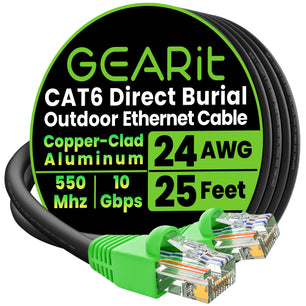
- Value builds: For non‑critical links on a budget, copper‑clad aluminum can be considered with conservative lengths and loads. See Cat6 CCA Outdoor Ethernet Cable for Direct Burial, Black. Planning tools and time matter too—check Bulk Cable vs Pre‑Made Patch: Termination Tools and Cost Worksheet.
- Throughput, EMI, and grounding: Match cable category to speed and distance, and pick shielding when routing near motors or high‑voltage conductors. For tradeoffs and bonding guidance, review Shielded vs Unshielded (S/FTP vs UTP): How to Reduce Interference at Home and, for high‑EMI shops or farms, Industrial Ethernet Quick Start: Picking Cable for Noisy Environments.
- Length limits and PoE: Keep total copper distance within spec and budget PoE properly for cameras and access points. See Patch Cable Length Limits and When You Need a Booster or Longer Run Strategy and PoE and PoE+: Cable Gauge and Distance Planning for Cameras and APs.
Direct‑Burial Speaker Wire for patios and gardens
- Use CL3‑rated, sunlight‑resistant jackets: For 4‑ohm loads or longer runs, upsize gauge to limit loss. A durable trunk for multi‑zone wiring is 12‑AWG Direct‑Burial 4‑Conductor Speaker Wire (CL3), which supports bi‑amp/bi‑wire layouts and clean home‑to‑yard distribution.
- Very long or high‑power paths: Choose heavier copper such as 10‑AWG Direct‑Burial CL3 to preserve headroom and damping factor over distance.
- Cost‑conscious zones: For modest distances to 8‑ohm pairs, 14‑AWG CL3 Direct‑Burial Speaker Wire balances resistance and price. For multi‑drop runs with lower current needs, a lighter trunk like 16‑AWG 4‑Conductor CL3 can simplify daisy‑chains.
Outdoor extension cords for tools and lights
- Jacket matters: Flexible cold‑weather SJEOW or tough SJTW cords handle temperature and abrasion better than indoor cords. For long temporary runs with better winter flexibility, see the 100‑ft SJEOW Extension Cord (14/3).
- Size for distance and load: Longer lengths and higher amps call for thicker conductors (lower AWG) to reduce voltage drop. Always use outdoor receptacles protected by GFCI.
Decide: Direct Burial vs Conduit vs Exposed Runs
Use this quick matrix to pick a protection strategy. You can also mix approaches—direct bury the long middle section and sleeve the last few feet in conduit where the cable emerges. For jacket choice and when burial pays off, see Outdoor Ethernet: Direct‑Burial vs UV‑Resistant Jackets and When to Use Each.
| Scenario | Pros | Cons | Best For |
|---|---|---|---|
| Direct Burial (outdoor‑rated cable) | Fast install, fewer fittings, moisture‑resistant jackets | Harder to upgrade later; splices must be sealed carefully | Residential shed links, landscape audio, long camera runs |
| Conduit (PVC or rigid) | Mechanical protection, easier future pulls, defined path | More labor and parts; water can collect if not planned | Driveway crossings, garden beds, busy walkways |
| Exposed, UV‑rated surface route | No trenching, quick service access | Physical damage risk; requires strain relief and shielding where noisy | Fence lines, soffits, under‑deck runs |
Planning a longer run or comparing premade vs on‑site termination? See Bulk Cable vs Pre‑Made Patch: Termination Tools and Cost Worksheet. GEARit’s outdoor Ethernet options are pre‑terminated to simplify installs and avoid on‑site crimping.
Water Control: Keep Moisture Out and Moving Away
Water is the #1 enemy of outdoor wiring. Block entry at terminations, seal splices, and promote drainage so water doesn’t sit against jackets.
- Seal the weak points: Use weather‑rated boxes with gaskets and cable glands. For underground splices, combine gel‑filled kits and adhesive‑lined heat‑shrink before placing the joint in a sealed enclosure.
- Encourage drainage: In wet soils, add a thin sand or gravel bed so water can pass without pooling against the cable.
- Elevate plug connections: Keep temporary cord connections off soil and under in‑use covers; add drip loops to shed rain.
Conduit: Where It Helps Most
Conduit adds impact protection, segments the path at grade changes, and keeps edges from nicking jackets.
- Use sleeves at transitions: Run PVC or rigid conduit at entry/exit points—typically 12 inches above grade and at least a shovel’s depth below—to keep surface water from funneling into a trench.
- Prefer long sweeps: Avoid tight elbows that scrape jackets or make future pulls tough. Add a pull string and oversize the conduit for upgrades.
- Blend approaches: Even with direct‑burial cable, short conduit stubs protect where cables rise along posts, fences, or foundations.
Trenching and Burial Basics
- Plan the route: Request utility locates before you dig and pick the straightest practical path with room for gentle bends.
- Bed and backfill: Lay cable on smooth soil or sand and hand‑backfill the first few inches to remove sharp rocks before replacing native soil.
- Depth and marking: Follow local code for burial depths. As a planning baseline for low‑voltage, many residential runs land around 12–24 inches with a marker tape above—verify locally before trenching.
Regional Tips for U.S. Installs
- Pacific Northwest (wet, cool): Prioritize sealed terminations and drainage layers; keep boxes off mulch beds that trap moisture.
- Southwest (high UV and heat): Choose UV‑resistant jackets; avoid dark rooftop surfaces; add standoffs for air gaps where possible.
- Midwest/Northeast (freeze–thaw): Leave service loops and avoid taut spans so expansion or ground heave doesn’t stress terminations.
- Gulf Coast/Southeast (humidity, storms): Reinforce gaskets, use GFCI everywhere outdoors, and secure overhead spans with proper strain relief.
Device‑Specific Do’s and Don’ts
Ethernet
- Do: Use outdoor‑rated, UV‑resistant cable; choose shielding for noisy routes and bond per hardware guidance. For fit‑for‑purpose planning, start with Industrial Ethernet Quick Start: Picking Cable for Noisy Environments.
- Don’t: Share conduit with AC power or crush twists with tight staples or bends. For bend‑sensitive layouts, see Flat vs Round Ethernet: Bend Radius, Under‑Carpet Runs, and Trade‑offs.
- Plan PoE properly: Match wattage and distance to cable gauge; review budgets in PoE and PoE+: Cable Gauge and Distance Planning for Cameras and APs. For overall run limits, see Patch Cable Length Limits and When You Need a Booster or Longer Run Strategy.
Speaker Wire
- Do: Use CL3‑rated, direct‑burial cable and terminate in weather‑sealed enclosures. CL3 jackets are built for UV and wet‑location exposure. For selection tips, the 12‑AWG 4‑Conductor CL3 is a strong multi‑zone trunk where two speakers share a single run.
- Don’t: Mix aluminum and copper on the same leg or leave splices unsealed underground.
- Sizing rule of thumb: Keep voltage drop under roughly 5%: step up gauge for 4‑ohm loads, long paths, or higher amplifier power. If you’re unsure, compare 14‑AWG, 12‑AWG, and 10‑AWG options against your distance.
Temporary Power
- Do: Use outdoor‑rated cords with intact molded plugs and strain relief. The 100‑ft SJEOW Extension Cord (14/3) stays flexible in cold weather for seasonal lights and light‑duty tools.
- Don’t: Run under doors/windows where cords can be pinched; avoid standing water; protect with GFCI.
Installation Workflow That Resists Weather and Water
- Survey and design: Identify device locations, entry/exit points, and any high‑EMI zones. Pick shielded or unshielded Ethernet per Shielded vs Unshielded.
- Choose the run type: Decide on direct burial, conduit, or exposed routing using the matrix above.
- Stage materials: Cable, conduit stubs, weatherproof boxes, glands, gel splices, adhesive‑lined heat‑shrink, and marker tape.
- Trench and sleeve: Cut a straight path with gentle bends; add short conduit sleeves at transitions.
- Lay and protect: Bed cable on sand/loam; avoid sharp rocks; maintain generous bend radius.
- Seal and test: Make drip loops, tighten glands, seal splices, then test link and PoE load before final backfill. If something misbehaves, use Troubleshooting Guide: Common Ethernet Failures and How to Test.
Example Product Fits by Use Case
- Shed or camera run with burial plus short exposures: Cat6 Outdoor Ethernet Cable - S/FTP Direct Burial handles soil contact and endpoint weather sealing.
- Quick fence‑line patch to an AP: Cat7 Outdoor Ethernet Patch Cable offers robust shielding for short exposed runs.
- Budget‑minded outbuilding link with careful distance planning: Cat6 CCA Outdoor Ethernet Cable can work for non‑critical links when lengths and PoE loads are modest.
- Backyard audio trunk serving two speakers on one pull: 12‑AWG 4‑Conductor CL3 simplifies multi‑zone layouts; step to 10‑AWG CL3 for long/high‑power paths or use 14‑AWG CL3 for shorter 8‑ohm runs. For lighter multi‑drop zones, 16‑AWG 4‑Conductor fits.
Frequently Asked Questions
Do I need conduit for outdoor Ethernet?
Not always. Direct‑burial outdoor cable can be laid in soil without conduit, which speeds installation. Conduit is smart at transitions (exits/entries), in high‑traffic areas, or where future upgrades are likely. For a deeper comparison, see Direct‑Burial vs UV‑Resistant Jackets.
How deep should I bury low‑voltage cable?
Depth requirements vary by jurisdiction. As a planning baseline for many residential low‑voltage runs, 12–24 inches with marker tape is common—verify with your local code office before trenching.
What’s the maximum length for an outdoor Ethernet run?
Typical copper Ethernet runs target up to 100 meters end‑to‑end, including patches. Route planning, PoE load, and link speed can change the margin; get practical limits in Patch Cable Length Limits.
Which cable should I choose for PoE cameras?
Use outdoor‑rated Ethernet sized for distance and wattage. Shielding helps near electrical noise. For watt budgeting and gauge tradeoffs, see PoE and PoE+: Cable Gauge and Distance Planning for Cameras and APs.
Next Steps
Map your route, pick the run style (burial, conduit, or exposed), and match cable to speed, distance, and environment. If you’ll work near power or machinery, review Industrial Ethernet Quick Start. If a link underperforms after installation, walk through Common Ethernet Failures and How to Test to isolate the fault fast.


