

Planning a wired network usually starts with one decision: pull bulk Ethernet and terminate onsite, or use pre‑made patch cords in measured lengths. This guide explains where each approach fits, the tools you’ll actually use, practical U.S. installer tips, and a fill‑in worksheet to estimate real‑world costs for homes and small businesses. GEARit primarily supplies pre‑terminated Ethernet cables; if you need fixed in‑wall terminations, you can still evaluate the bulk‑cable path using the matrix and worksheet below.
Quick answer: when each option makes sense
- Choose pre‑made patch for short, visible, or movable runs (desks, gaming setups, classrooms, lab benches) where speed, flexibility, and color coding matter. Stranded 24 AWG conductors and snagless boots reduce latch stress when cables are moved frequently. For everyday device leads, see a durable option like Cat6 Ethernet Patch Cable – Snagless, 24AWG (Black).
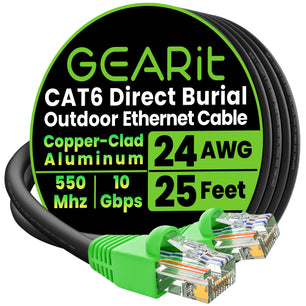
- Choose bulk cable for fixed in‑wall, long, or irregular routes where you’ll terminate to keystones or a patch panel. It’s cleaner at outlets, scales well for many drops, and can reduce per‑drop material costs—especially on outdoor/direct‑burial projects where a purpose‑built, weather‑rated cord like Cat6 Outdoor Ethernet Cable, 23AWG, Shielded, Direct‑Burial is appropriate for exposed runs.
Decision table: Bulk vs pre‑made by priority
Match the approach to your constraints.
| Priority | Pre‑Made Patch | Bulk Cable |
|---|---|---|
| Speed to deploy | Fastest — plug and go | Slower — measure, pull, terminate, test |
| Run length variety | Limited to stocked lengths | Custom fit for any pathway |
| Moves/changes later | Great — flexible and reusable | Harder — new pull or re‑terminate |
| Look at outlets/walls | Visible slack can be messy | Clean keystone and patch‑panel finish |
| Up‑front cost | Low — no tools, pay per cable | Higher — tools, connectors, test gear |
| Per‑drop cost at scale | Higher for many identical drops | Lower when doing dozens of terminations |
| Outdoor/direct burial | Specialty cords required | Purpose‑built bulk/field termination options |
| Failure risk | Factory‑terminated and verified | Installer skill determines quality; testing required |
What to look for in pre‑made patch cords
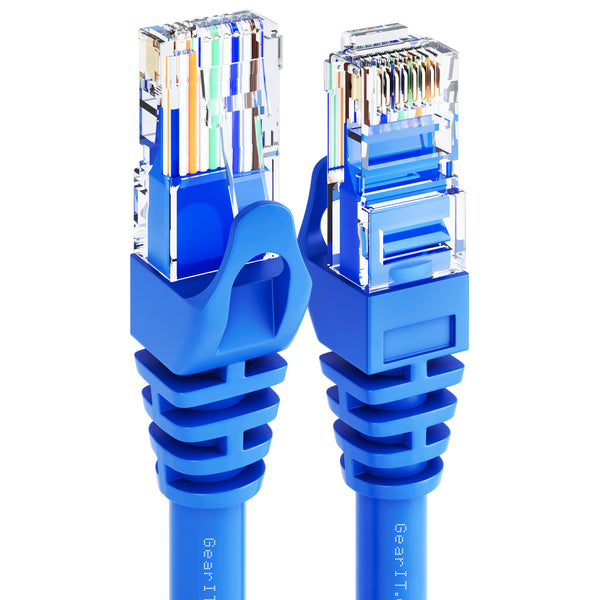
- Stranded conductors (typically 24 AWG) for flexibility and repeated movement. For soft, easy‑to‑route tails at the desk or rack, consider the Premium Flexible Soft‑Tab Cat6 Patch (Blue).
- Snagless or soft‑boot design to protect latches in tight spaces. A softer boot is easier to release; see Premium Flexible Soft‑Tab Cat6 Patch (Black).
- Color coding for quick identification (e.g., orange for uplinks, white for APs, yellow for VoIP). Helpful choices include Cat6 Snagless Patch (Orange), Cat6 Snagless Patch (White), and Cat6 Snagless Patch (Yellow).
- Length planning to avoid excess slack that snags or hides dust. For longer device leads, step up in small increments rather than overbuying. For speed targets (1G to 10G), compare categories in Cat6 vs Cat6a vs Cat8: Pick the Right Cable for 1G, 2.5G, 5G, and 10G and review limits in Patch Cable Length Limits and When You Need a Booster or Longer Run Strategy.
Bulk cable: tools and parts you’ll actually use
Field termination is straightforward with the right kit. Plan for these before your first pull:
- Cable prep: jacket stripper, electrician’s scissors, flush cutters, fish tape/rods, and a tape measure.
- Termination type: RJ45 crimp tool for modular plugs (pass‑through or standard matched to your ends), or a punchdown tool for keystone jacks and patch panels.
- Connector compatibility: use solid‑core‑rated RJ45 ends for solid bulk cable; use stranded‑rated ends for patch assemblies. Mixing types causes intermittent failures.
- Tester: at minimum a continuity/wiremap tester. For critical links, verify length and PoE under load. For step‑by‑step troubleshooting, see Troubleshooting Guide: Common Ethernet Failures and How to Test.
- Dressing and protection: strain‑relief boots on field‑crimped plugs, keystone dust caps, hook‑and‑loop ties, and printed labels.
Skill tips that prevent do‑overs
- Follow T568B (or T568A) consistently end‑to‑end. Keep twists to the contact to minimize crosstalk.
- Mind bend radius (about 4× the cable diameter for UTP) and avoid zip‑tie crushing. If you’re planning tight spaces or under‑carpet runs, review Flat vs Round Ethernet: Bend Radius, Under‑Carpet Runs, and Trade‑offs.
- Label and document every drop at the jack and panel; test and log results before closing walls.
Outdoor, PoE, and high‑EMI considerations
- Outdoor/direct burial: choose UV‑resistant, moisture‑blocking jackets and consider shielding. For planning details, start with Outdoor Ethernet: Direct‑Burial vs UV‑Resistant Jackets and When to Use Each and Weather, Water, and Conduit: Best Practices for Outdoor Installs | GEARit. For exposed soil runs or fence lines, a shielded, solid‑copper design like Cat6 Outdoor Ethernet Cable, 23AWG, Shielded, Direct‑Burial resists sunlight and moisture.
- PoE cameras and access points: longer PoE runs benefit from heavier gauge conductors and clean terminations. See PoE and PoE+: Cable Gauge and Distance Planning for Cameras and APs.
- High‑EMI venues: consider shielded cabling and ruggedized connectors where appropriate. For use cases, read Industrial Ethernet Quick Start: Picking Cable for Noisy Environments and, for stage/AV, EtherCON and Pro Audio Networking: When Ruggedized RJ45 Makes Sense.
Cost worksheet you can fill in
Estimate the true cost of each approach on your project. Replace placeholders with your numbers. Labor examples below reflect common U.S. scenarios—adjust for your local market.
| Line item | Your qty | Your unit cost | Your labor mins | Calc |
|---|---|---|---|---|
| Pre‑made patch cords (enter per‑cord price) | — enter qty — | — $/cord — | 1 | = qty × unit cost; labor = qty × 1 min |
| Bulk cable (ft) from pull(s) | — enter ft — | — $/ft — | — | = ft × unit cost |
| RJ45 plugs (solid or stranded rated) | — enter qty — | — $/plug — | 3 per plug | = qty × unit cost; labor = qty × 3 min |
| Keystone jacks | — enter qty — | — $/jack — | 6 per jack | = qty × unit cost; labor = qty × 6 min |
| Patch panel ports | — enter qty — | — $/port — | 4 per port | = qty × unit cost; labor = qty × 4 min |
| Consumables (boots, labels, hook‑and‑loop) | 1 lot | — $/lot — | — | = unit cost |
| Tools (crimper, punchdown, tester) | 1 kit | — $/kit — | — | = amortize over expected drops (e.g., cost ÷ 100) |
| Travel/setup time | — enter hrs — | — $/hr — | — | = hours × labor rate |
| Rework allowance (e.g., 5%) | — | — | — | = materials × 0.05 + labor × 0.05 |
| Total: Pre‑made scenario | — | — | — | = sum of pre‑made line items |
| Total: Bulk scenario | — | — | — | = sum of bulk line items |
Tip: For very small jobs (one to four device leads), pre‑made usually wins once you include tool cost and setup time. For dozens of wall drops with a central patch panel, bulk typically lowers the per‑drop total and delivers a cleaner finish.
Scenario‑based recommendations
- Home office or gaming in a rental: Use factory‑terminated cords for speed and low mess. A short, flexible lead like the Premium Flexible Soft‑Tab Cat6 Patch (Blue) routes easily behind furniture. For latency‑first setups, see Gaming Over Ethernet: Low‑Latency Setup Without Overbuying.
- New construction (United States) with many outlets: Pull bulk solid Cat6 to each location, terminate to keystones, and dress to a patch panel; then use short patch cords from panel to switch. If you’re targeting 2.5G/5G/10G, compare categories in Cat6 vs Cat6a vs Cat8: Pick the Right Cable for 1G, 2.5G, 5G, and 10G.
- Outdoor cameras or garden Wi‑Fi in sun‑heavy regions: Choose UV‑resistant, direct‑burial cabling and gasketed boxes. Start with Outdoor Ethernet: Direct‑Burial vs UV‑Resistant Jackets and When to Use Each and Weather, Water, and Conduit: Best Practices for Outdoor Installs | GEARit. For exposed soil runs, see Cat6 Outdoor Ethernet Cable, 23AWG, Shielded, Direct‑Burial.
- Industrial/AV spaces with interference: Consider shielded cable and ruggedized RJ45 where appropriate; see Industrial Ethernet Quick Start: Picking Cable for Noisy Environments and EtherCON and Pro Audio Networking: When Ruggedized RJ45 Makes Sense.
How to choose patch lengths that manage neatly
Pick the shortest cable that reaches with a gentle service loop; this prevents tangles and protects latches. If a single patch must bridge a longer gap, confirm distance and speed expectations in Patch Cable Length Limits and When You Need a Booster or Longer Run Strategy. For tidy, neutral runs to access points and desk hubs, a light color such as Cat6 Snagless Patch (White) blends into trim and wall paint.
Troubleshooting and verification
Even with factory‑made cords, issues can trace back to damaged jacks, kinked cable, or mismatched switch settings. A simple wiremap/continuity test and a port swap are fast first steps; see the step‑by‑step Troubleshooting Guide: Common Ethernet Failures and How to Test for a short diagnostic flow you can run before rolling a truck.
Frequently Asked Questions
Will pre‑made patch cords limit my network speed?
No, as long as the patch cord category matches your target speed and the total channel length and components meet spec. For 1G to 10G guidance by category, see Cat6 vs Cat6a vs Cat8: Pick the Right Cable for 1G, 2.5G, 5G, and 10G.
When should I choose shielded cables?
Use shielded cable in areas with heavy EMI (large motors, lighting dimmers, long parallel AC runs) or for outdoor runs that may see electrical noise. For a quick primer, read Industrial Ethernet Quick Start: Picking Cable for Noisy Environments.
How many spare patch cords should I keep on hand?
For homes, keep one spare per critical device plus one extra in a different length. For small offices, keep 10–20% spares in common lengths and colors to cover desk moves and switch changes.
Can I run a pre‑made patch cord outdoors?
Only if it’s built for the environment. For sun, moisture, or direct‑burial installs, use a weather‑rated design such as Cat6 Outdoor Ethernet Cable, 23AWG, Shielded, Direct‑Burial and follow the practices in Weather, Water, and Conduit: Best Practices for Outdoor Installs | GEARit.
Next steps
If you need fast deployment with tidy, color‑coded dressing, choose pre‑made patch cords in the right category and length. Start with flexible options like Premium Flexible Soft‑Tab Cat6 Patch (Blue) and staple utility lengths such as Cat6 Snagless Patch (Black). For outdoor devices or long garden runs, plan with the guides above and select Cat6 Outdoor Ethernet Cable, 23AWG, Shielded, Direct‑Burial where appropriate.