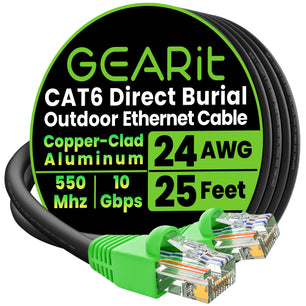


If you need Ethernet outside—running to a detached garage, a backyard office, or security cameras—the first decision is jacket type. Do you need a true direct‑burial cable rated to live underground, or is a UV‑resistant cable fine for above‑ground runs on a wall, fence, or soffit? This guide explains the differences, tradeoffs, and how to pick the right option for your distances, Power over Ethernet (PoE) loads, and local conditions across the U.S.
Quick answer
- Pick direct‑burial for underground paths, frequent moisture, or areas prone to flooding or irrigation overspray. Thicker LLDPE/HDPE jackets are built to resist water, soil, and abrasion.
- Pick UV‑resistant (non‑burial) for cables exposed to sun and air—mounted along siding, soffits, or fences—where you can keep connectors protected and away from standing water.
- Use conduit for physical protection, cleaner service loops, and easier replacement—especially in rocky soil or where lawn tools are a risk. For sealing, drip‑loops, and routing basics, see Weather, Water, and Conduit: Best Practices for Outdoor Installs | GEARit.
What the jacket really does outdoors
In outdoor Ethernet, the jacket isn’t just cosmetic—it determines how well the cable tolerates sun, water, abrasion, and temperature swings.
- Direct‑burial jackets (LLDPE/HDPE): Thick, rugged polyethylene that resists water ingress, soil chemistry, and abrasion. Often paired with heavier conductors and optional shielding for stable PoE on longer runs. A fit for trenches, planter beds, or routes that may sit damp after rain.
- UV‑resistant jackets: Polyethylene or PVC blended with UV stabilizers to survive years of sunlight without cracking. Intended for above‑ground routing where the cable can dry out and won’t be in prolonged contact with soil.
Direct‑Burial vs UV‑Resistant: side‑by‑side comparison
Use this compact matrix to match the jacket to your job.
| Criteria | Direct‑Burial Jacket | UV‑Resistant Jacket |
|---|---|---|
| Primary use | Underground or in contact with soil; damp areas | Above‑ground on structures (soffits, walls, fences) |
| Moisture defense | High—LLDPE/HDPE resists water and soil; abrasion‑tough | Moderate—weather/UV tolerant but not meant to sit in wet soil |
| UV/sunlight tolerance | High | High (purpose‑built) |
| Abrasion/impact | High—thicker jacket protects against rocks and tools | Moderate—route carefully and secure with UV‑rated clips |
| Typical cable build | Cat6; heavier gauge; shielded variants available | Cat6/Cat7 pre‑terminated patches; shielding available |
| Install effort | Trenching; conduit recommended in rocky/high‑traffic soil | Surface routing; secure every 12–24 inches as needed |
| Relative cost | Higher per foot for materials and build | Lower for short surface runs |
Choose by scenario
Underground to a detached building
For house‑to‑garage, shed, or pool‑house links, a burial‑rated Cat6 with a rugged LLDPE jacket is the safe default. If you’ll bury directly in soil, heavier jackets and optional shielding help the cable handle long‑term moisture and incidental impacts. A practical pick is the Cat6 outdoor direct‑burial S/FTP cable, which pairs a tough LLDPE jacket with shielding for noisy or lightning‑prone routes.
Above‑ground along siding, soffits, or a fence
When you can route and secure the cable out of harm’s way, a UV‑resistant outdoor patch cable keeps the install simple. It’s a good match for short camera drops or APs under eaves. For shielded, weather‑resistant above‑ground runs where pre‑terminated convenience helps, consider the Cat7 Outdoor Ethernet Patch Cable (S/FTP) to minimize interference near soffit lighting and HVAC equipment.
Budget‑conscious underground runs in conduit
If you’re placing the cable inside sealed conduit with proper drainage and a pull‑string, a value‑oriented Cat6 CCA outdoor direct‑burial cable can be cost‑effective. The conduit adds abrasion protection and serviceability; the cable’s outdoor jacket handles incidental moisture. For DIY planning and realistic tool/termination time, see Bulk Cable vs Pre‑Made Patch: Termination Tools and Cost Worksheet.
Installation planning for U.S. conditions
- Soil and climate: In the Midwest and Northeast, freeze–thaw cycles shift soil; give your trench extra depth and add gentle service loops at each end. In the Southwest, strong sun and heat argue for shaded routing and UV‑rated clamps. Coastal regions benefit from shielding and corrosion‑resistant hardware.
- Conduit helps even when burying rated cable: It protects against gardening tools and simplifies future upgrades. For drip‑loops, entry sealing, and water management, review Weather, Water, and Conduit: Best Practices for Outdoor Installs | GEARit.
- Distance and PoE load: A standard Ethernet channel is typically planned to 100 meters end‑to‑end. High‑draw PoE devices on long runs benefit from heavier‑gauge conductors and minimizing patch‑to‑patch hops. For planning details, see PoE and PoE+: Cable Gauge and Distance Planning for Cameras and APs and Patch Cable Length Limits and When You Need a Booster or Longer Run Strategy.
- Transitions indoors: Use a short indoor‑rated patch from the entry point to your switch, and seal penetrations against insects and moisture. A flexible, snagless option is this Cat6 indoor patch cable for clean rack or switch connections.
- Call before you dig: In the U.S., contact 811 to mark utilities before trenching. Local jurisdictions may also specify minimum burial depths when sharing a trench with power or irrigation.
Shielding and noise control
Outdoor paths often run near AC mains, LED drivers, pool equipment, or HVAC condensers. Shielded cable (FTP/SFTP) can reduce interference and improve stability on longer or PoE‑powered links. If your route hugs power or passes near motors, start with a shielded outdoor cable. For a deeper primer, read Shielded vs Unshielded (S/FTP vs UTP): How to Reduce Interference at Home and, for higher‑EMI jobs, Industrial Ethernet Quick Start: Picking Cable for Noisy Environments.
Category and speed: Cat6 is the outdoor workhorse
Most outdoor runs targeting 1G or 2.5G use Cat6. If you’re planning for 5G/10G, keep distances short, choose high‑quality conductors, and maintain bend radius. For help aligning cable category with link speed and length, see Cat6 vs Cat6a vs Cat8: Pick the Right Cable for 1G, 2.5G, 5G, and 10G.
Recommended picks by use case
- Buried house‑to‑garage link with electrical nearby: Cat6 outdoor direct‑burial S/FTP. Why: rugged LLDPE jacket, shielding for EMI, heavier gauge for PoE stability. Tradeoff: thicker jacket, stiffer pull. Consider the Cat6 outdoor direct‑burial S/FTP cable.
- Cost‑sensitive underground run inside conduit: Cat6 outdoor CCA direct‑burial. Why: outdoor jacket rated for burial; budget‑friendly for long distances in protected conduit. Tradeoff: CCA isn’t suited for repeated flexing or aggressive terminations. See Cat6 CCA outdoor direct‑burial.
- Short, above‑ground camera drops under eaves: Shielded outdoor patch cable. Why: pre‑terminated convenience, UV/weather resistance, and shielding near lighting drivers. Tradeoff: fixed lengths are less flexible if routing changes. A weather‑resistant option is the Cat7 Outdoor Ethernet Patch Cable (S/FTP).
Pre‑made vs. bulk: what makes sense to buy
GEARit focuses on reliable, pre‑terminated outdoor cables because they speed up small jobs and help prevent termination errors. Installers sometimes choose bulk cable for multiple drops or complex conduit paths; factor in termination tools, weather‑rated jacks, and your time. For a realistic cost/effort view, see Bulk Cable vs Pre‑Made Patch: Termination Tools and Cost Worksheet. If your planned route pushes length limits or needs mid‑span power/switching, also review Patch Cable Length Limits and When You Need a Booster or Longer Run Strategy.
Common mistakes to avoid
- Burying a non‑burial, thin UV‑only cable: It may work at first, then fail after a season of moisture exposure.
- Straight‑line pulls with no service loops: Add slack at both ends for future re‑terminations and equipment moves.
- Unprotected connectors outdoors: Keep terminations in weather‑protected boxes; avoid letting RJ45 ends sit in damp air.
- Ignoring interference: Long runs near power or pumps deserve shielded cable and careful separation.
- Overlooking speed vs distance: If you need 5G/10G, verify your planned category and channel length in Cat6 vs Cat6a vs Cat8.
Frequently Asked Questions
Can I bury a UV‑resistant cable if I put it in conduit?
Use a burial‑rated outdoor cable when the path is underground, even in conduit. Conduit adds protection, but condensation and small leaks still happen over time. For conduit layout tips, see outdoor conduit best practices.
How deep should I bury outdoor Ethernet?
Depth depends on local conditions and the presence of conduit. Aim for a depth that avoids routine garden tools and respects local codes; your city or county may specify minimums. Always call 811 before digging to have utilities marked.
Do I need shielded cable outdoors?
Not always. If your route runs parallel to AC wiring, near pumps or motors, or close to LED drivers, shielding helps reduce interference. For a quick primer, see Shielded vs Unshielded.
What category should I choose for cameras and access points?
Cat6 is a dependable default for 1G and 2.5G links and typical PoE power levels. For 5G/10G, keep runs shorter and validate your full channel plan in Cat6 vs Cat6a vs Cat8 and PoE distance planning.
Next steps
If your path is underground or regularly damp, choose a direct‑burial jacket; if it’s mounted under eaves or along a fence, a UV‑resistant outdoor patch is usually sufficient. Sketch your route, confirm length and PoE draw, and review the related guides linked above for conduit, shielding, and category choices. This approach keeps your outdoor link reliable today and easier to service tomorrow.


