

If your PLCs, drives, HMIs, vision systems, or touring rigs share space with motors, VFDs, welders, dimmers, or high‑current feeders, you’re in a high‑EMI environment. Use this quick start to choose cabling that keeps links stable and deterministic on a U.S. plant floor or in commercial venues.
For a foundation on categories and where 1G/2.5G/5G/10G make sense, see Cat6 vs Cat6a vs Cat8: Pick the Right Cable. If you’re weighing shielded vs unshielded at home or in light‑EMI areas, this refresher helps: Shielded vs Unshielded: How to Reduce Interference.
What makes an environment “noisy” (and why it matters)
- EMI/RFI sources: VFDs, soft‑starters, servo drives, welders, switching supplies, two‑way radios, and fluorescent/LED drivers inject wideband noise that can cause CRC errors, retries, and dropped links.
- Coupling paths: Long parallel runs next to feeders, mixed trays with power, and tightly bundled data increase conducted and radiated coupling.
- Typical symptoms: Intermittent link flaps, speed “stepping down,” or bursty packet loss when nearby machinery starts or loads change.
Shielding 101: the fastest lever against noise
Shielding reduces external interference and alien/pair‑to‑pair crosstalk. Match construction to noise severity and your termination skill.
| Construction | Noise immunity | Termination complexity | Flexibility | Typical fit |
|---|---|---|---|---|
| UTP (unshielded) | Low | Easy | High | Clean office or short inside‑panel jumpers away from drives |
| F/UTP (overall foil) | Moderate | Moderate | Moderate | Mixed‑use runs with light to moderate EMI |
| U/FTP (foil per pair) | High | Moderate | Moderate | Zones with drives/relays where pair isolation helps |
| S/FTP (braid + foil per pair) | Very high | Higher (ensure 360° bond) | Lower | Heavy EMI near VFDs/welders; critical 1G/10G uptime |
Need a ruggedized RJ45 for touring or portable test stands? See when ruggedized RJ45 makes sense.
Choose the performance class (Cat) for speed and distance
- Cat6: Reliable 1G to 100 m; 10G to ~55 m in ideal conditions.
- Cat6a: Designed for 10G to 100 m with better alien‑crosstalk control—often the safer default across noisy zones or for plant backbones.
Still deciding? Compare tradeoffs in Cat6 vs Cat6a vs Cat8.
Jackets and mechanical protection for harsh installs
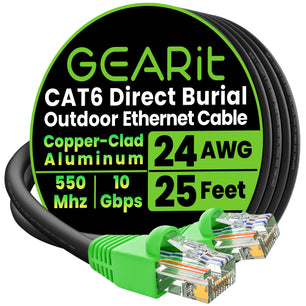
- Outdoor and UV exposure: Favor UV‑resistant jackets and water‑blocking designs. For direct‑burial between buildings or in conduit transitions, a shielded outdoor cable like GEARit Cat6 Outdoor FTP Direct‑Burial pairs EMI control with a durable LLDPE jacket.
- Short outdoor patch segments: For weather‑exposed jumpers near rooftop HVAC or temporary links, a compact Cat7 Outdoor S/FTP Patch adds shielding and weather resistance.
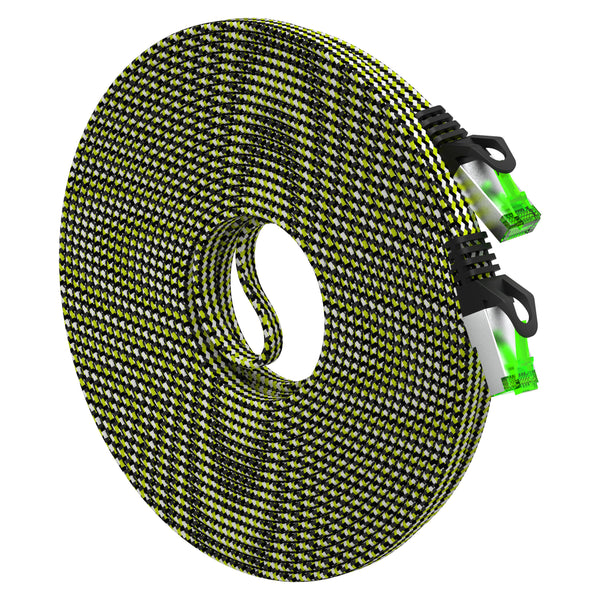
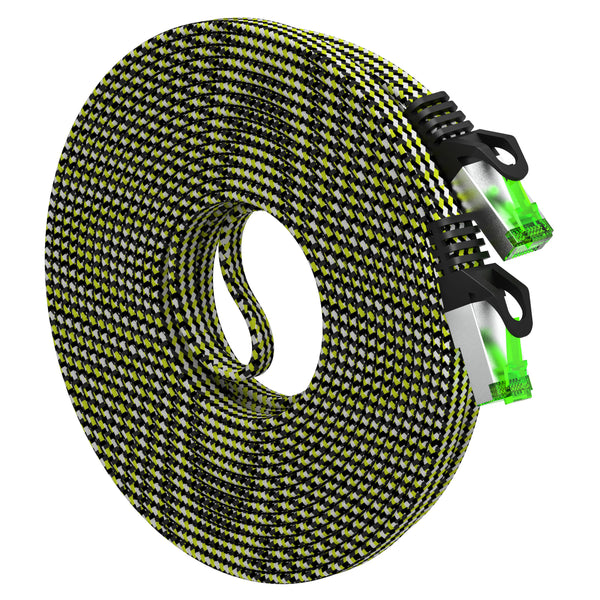
- Flat/low‑profile routes: Flat cords ease tight bends and under‑carpet paths but can trade off shielding options. Read the pros/cons in Flat vs Round Ethernet before using one near EMI sources.
Connectors, termination, and grounding that actually work
- Use shield‑rated RJ45 ends and jacks: Metal shells with drain‑wire or foil continuity allow the shield to bond to grounded equipment or patch panels. Maintain 360° coverage into the connector—avoid long pigtails.
- Bonding strategy: Follow your U.S. facility grounding scheme to provide a low‑impedance path for noise while avoiding loops. Keep patch panels and enclosures bonded per site standards.
- Color‑coded inside‑panel jumpers: In truly low‑EMI cabinets, short UTP jumpers are acceptable and easier to dress; a flexible stranded option like GEARit Cat6 Stranded Patch keeps bends easy. For length planning, see Patch Cable Length Limits.
Quick picks for common noisy scenarios
- General plant floor with VFDs/contactors nearby: Start with Cat6 or Cat6a in U/FTP or S/FTP, with shield continuity at endpoints. For a shielding refresher, see Shielded vs Unshielded.
- 10G backbone across mixed‑EMI zones (to 100 m): Cat6a S/FTP to maximize headroom and reduce alien crosstalk.
- Between buildings or rooftop to enclosure: Use outdoor‑rated, shielded cable and plan bonding/surge at entry points. For burial or sun exposure, consider GEARit Cat6 Outdoor FTP Direct‑Burial. For planning tips, see Outdoor Ethernet: Direct‑Burial vs UV‑Resistant and Weather, Water, and Conduit Best Practices.
- Temporary rigs near dimmers or mobile welders: Use shielded S/FTP patch segments with rugged connectors where possible. For short weather‑resistant jumpers, a Cat7 Outdoor S/FTP Patch is a practical choice.
- Low‑noise office side of the wall (inside panel): Short, flexible UTP patches are fine when physically separated from power runs; see patch length guidance and use a stranded option such as GEARit Cat6 Stranded Patch. Avoid UTP once you exit the low‑EMI area.
Layout rules that improve noise immunity
- Separate power and data: Keep inches of separation in shared trays; cross power at 90° when you must intersect.
- Shorten parallel exposure: Re‑route to reduce long, adjacent runs near 3‑phase feeders or VFD output leads.
- Respect bend radius and avoid tight coils: Coils behave like inductors and can concentrate noise.
- Verify performance: Certify critical links and confirm shield bonding/continuity. If issues persist, see the Troubleshooting Guide.
Decision matrix: pick by environment and priority
Use this compact table to turn conditions into a cable choice.
| Environment | Priority | Recommended build | Why it fits |
|---|---|---|---|
| Plant floor with drives | Uptime under EMI | Cat6a S/FTP | Better alien‑crosstalk and high shielding for 10G to 100 m |
| Mixed office/production | Value + noise margin | Cat6 U/FTP | Pair foil adds isolation without S/FTP stiffness |
| Outdoor inter‑building (U.S.) | Weather + EMI | Shielded, UV‑resistant direct‑burial | Jacket resists sun/moisture; shield tames external noise |
| Temporary outdoor rig | Quick setup + weather | S/FTP outdoor patch | Shielding plus sealed jacket for short runs |
| Inside a low‑EMI cabinet | Flexibility | Stranded Cat6 UTP patch | Easy dressing; keep away from power |
60‑second buy/verify checklist
- EMI level: Light (F/UTP) → Moderate (U/FTP) → Heavy (S/FTP).
- Speed/distance: 1G short runs (Cat6) vs 10G to 100 m (Cat6a).
- Environment: Indoor panel, rooftop, inter‑building, or direct burial.
- Termination: Use shield‑rated RJ45; maintain 360° shield continuity; follow site bonding.
- Power & PoE: For cameras/APs, plan distance and gauge with PoE distance and gauge planning.
- Make vs buy: If you’re weighing pre‑terminated cords versus field termination, see Bulk Cable vs Pre‑Made Patch.
Frequently Asked Questions
Do I always need shielded cable in a plant?
No. Short, inside‑panel jumpers in truly low‑EMI zones can be UTP. But near motors, drives, welders, or dimmers, shielded constructions (U/FTP or S/FTP) materially improve stability.
Cat6 or Cat6a for noisy environments?
Cat6 handles most 1G links and some 10G up to roughly 55 m in ideal conditions. Cat6a is engineered for 10G to 100 m and tighter alien‑crosstalk control. If you’ll cross high‑EMI zones or need 10G headroom, Cat6a S/FTP is the safer default.
What about outdoor links between buildings in North America?
Use outdoor‑rated, UV‑resistant shielding and plan bonding/surge at building entries. For burial or sun exposure, a shielded option like GEARit Cat6 Outdoor FTP Direct‑Burial simplifies selection. For route planning, see Outdoor Ethernet.
Will shielding slow my network?
No. Shielding preserves signal integrity so you reach the category’s rated performance more consistently under EMI. Installation quality (bend radius, terminations, bonding) determines results.
Next steps
Map your routes, confirm EMI hotspots, then pick shielding from the table above. For outdoor segments, review weather and conduit best practices. If you need to weigh pre‑terminated cords versus field termination, see Bulk Cable vs Pre‑Made Patch. If a link won’t certify, work through the Troubleshooting Guide to isolate shielding or layout issues.