

Power that “just works” is what you want at a campground pedestal, in a home garage for EV charging, or when a generator keeps the lights on. The catch is that the right plug type, gauge, and cord length change with your setup and distance—and small mistakes (like the wrong adapter or an overly long, light‑gauge run) can show up as nuisance trips, hot plugs, or underperforming equipment. This Core Guide walks you through the essentials in plain English so you can match NEMA plug types to your RV, EV, or generator; size cords by length and load; choose the right outdoor jacket; and connect safely with confidence.
We’ll zoom in on real‑world U.S. scenarios—30‑amp TT‑30 and 50‑amp 14‑50 services for RVs, common generator connections like L14‑30 and L5‑30, and practical advice for portable EV charging from a 14‑50 receptacle. Along the way, you’ll find decision tools, compact comparison tables, and focused links to deeper explainer guides should you want to double‑click on a specific topic.
Start here: a plain‑English map of common U.S. plug types
Most power questions in RV parks, residential garages, and small jobsite or home‑backup generator setups trace back to a few NEMA patterns. Get these right and the rest—gauge, length, jacket—falls into place.
- TT‑30 (30A RV, 120 V single‑pole): Three blades: one hot, one neutral, one ground. Feeds up to 30 amps at 120 volts (about 3,600 watts) to most travel trailers and many Class C rigs. If you’re still sorting out what 30A service can and can’t run compared with 50A, see RV Power Basics: TT‑30 vs 14‑50 Explained with Use Cases.
- 14‑50 (50A RV/EV, 120/240 V split‑phase): Four blades: two hots, neutral, and ground. In RVs, it provides two separate 120 V, 50 A legs that together can support high combined loads (multiple A/Cs, microwave plus other appliances). Also common as a convenience outlet for portable EV charging.
- L14‑30 (30A generator, 120/240 V twist‑lock): Two hots, neutral, and ground on a locking connector. Feeds transfer switches and distribution boxes that need split‑phase 120/240 V.
- L5‑30 (30A generator/RV, 120 V twist‑lock): One hot, neutral, and ground in a locking pattern. Powers single‑circuit 120 V loads, some food trucks, and RV equipment with a 30A 120 V inlet.
Those four cover the majority of U.S. portable power use. There are specialty connectors—like SS2‑50 in marinas or 14‑30 and 10‑30 in laundry rooms—but you’ll meet them mainly when using adapters, which we’ll cover later in this guide.
Decision checkpoint: match your service, distance, and environment
Before shopping cords or adapters, answer three questions. They’ll narrow your choices fast and reduce the odds of hot plugs or breaker trips:
- What service do you actually have? Confirm the outlet or pedestal type (TT‑30, 14‑50, L14‑30, L5‑30, etc.) and your device inlet (RV inlet, generator panel, EVSE plug).
- How far is the run? Longer cords mean more resistance and voltage drop. Plan length realistically and avoid “just in case” cord bloat.
- What’s the environment? Sun, heat, abrasion, and winter cold all influence jacket choice and handling. We’ll translate STW vs SJTW vs SJEOW below.
If you’d like help confirming connector differences, you’ll find clear diagrams and use‑case scenarios in RV Power Basics: TT‑30 vs 14‑50 Explained with Use Cases. For a step‑by‑step campsite routine that verifies what’s actually at the pedestal before you plug in, keep Campground Hookups Checklist: Before You Plug In handy.
Quick comparison: which connector, what it powers, and planning notes
Use this table as a fast cross‑reference. Then read the sections that follow for gauge, length, and jacket details.
| Connector | Voltage / Poles | Max Circuit Amps | Typical Uses | Planning Notes |
|---|---|---|---|---|
| TT‑30 (NEMA TT‑30) | 120 V, 1 hot + neutral + ground | 30 A | Travel trailers, many RV sites | Plan 10 AWG copper for 25–50 ft runs; manage voltage drop on longer distances. |
| 14‑50 (NEMA 14‑50) | 120/240 V split‑phase, 2 hots + neutral + ground | 50 A per leg (RV use) | Large RVs, EV portable charging | Use cords built with 6/3 + 8/1 copper; be realistic about length and combined loads. |
| L14‑30 (NEMA L14‑30) | 120/240 V split‑phase, locking | 30 A | Generators to transfer switches | Locking ends reduce disconnect risk; size gauge for distance and balance loads. |
| L5‑30 (NEMA L5‑30) | 120 V single‑pole, locking | 30 A | Generators to single 120 V inlets | Great for one‑circuit feeds; confirm your device is 120 V only. |
Gauge and length: how to keep voltage drop in check
Even the right connector can underperform if the copper inside your cord is too small for the distance and current. That’s why planning around voltage drop matters. Lower resistance equals cooler plugs and steadier voltage at your RV, EVSE, or panel.
For a deeper dive—including a quick, one‑line calculator and ready‑made tables tuned to 30A and 50A U.S. use—bookmark Voltage Drop Calculator: Picking the Right Gauge by Length (30A/50A). Here’s the short version to guide your buying decisions right now:
- Think in total distance out and back. Electricity makes a round trip. Longer one‑way runs double for resistance calculations.
- 30A RV cords (TT‑30): For common 25–50 ft runs, quality cords use 10 AWG copper conductors. If you routinely stretch past ~50 ft with heavy loads like A/C, consider stepping up the gauge or rethinking site placement to avoid sag.
- 50A RV cords (14‑50): Look for 6/3 + 8/1 copper construction—two 6 AWG hots plus 6 AWG neutral and an 8 AWG ground. This is the workhorse build for 25–50 ft lengths feeding larger rigs.
- Generator cords (L14‑30/L5‑30): Most 30A locking cords use 10 AWG copper. If you’re running long distances to a transfer switch or splitter box, evaluate drop—especially on high combined 120 V loads.
- Be mindful of “continuous load.” EV charging is continuous; many RV appliances in summer effectively behave that way too. Treat the weakest link in your chain—outlet, breaker, cord, adapter—as the cap on safe current.
If you prefer not to run math on the fly, the voltage‑drop tables and examples in Voltage Drop Calculator: Picking the Right Gauge by Length (30A/50A) turn length and gauge into a quick yes/no answer. They’re also helpful when comparing a shorter, heavier cord against a longer, lighter one for flexibility or reach.
Outdoor jackets decoded: STW vs SJTW vs SJEOW
Gauge gets a lot of attention, but the jacket determines how your cord behaves in sun, rain, heat, and sub‑freezing cold. It’s also a big factor in weight, flexibility, and abrasion resistance. If you work across seasons or coil cords often, jacket choice can be the difference between a gear bag you love and one you avoid.
For a complete breakdown of the letters, use cases, and storage tips, see Outdoor Use: STW vs SJTW Jackets, IP Ratings, and Storage. The essentials:
- SJTW: “Junior” service, outdoor‑rated thermoplastic jacket. Typically 300 V build, lighter and easier to handle. Great for moderate duty and frequent coiling.
- STW: Heavier, 600 V build for tougher duty and abrasion resistance. Common on 50A RV and 30A generator cords where sturdiness matters.
- SJEOW: A flexible elastomer jacket that stays supple in cold weather and resists oil. If you set up in winter or move cords a lot below freezing, it’s a welcome upgrade.
What about “waterproof ratings?” In consumer gear you’ll see IP codes describing ingress protection. They can help with enclosures and covers, but open‑blade plugs and cord ends aren’t meant to be submerged. Use weather‑resistant covers on outdoor receptacles and keep connections out of puddles and snow banks. You’ll find practical guidance for jacket choice and storage approaches—like the over‑under coil method—in Outdoor Use: STW vs SJTW Jackets, IP Ratings, and Storage.
RV campsites: safe hookups, right‑sized cords, and cool‑running plugs
Campground power is a mix of fresh, well‑maintained posts and older pedestals that have seen hard use. Worn contacts, sagging voltage on hot afternoons, and occasional miswiring do happen. A quick routine catches most problems before they reach your RV’s panel.
- Verify the post before you plug in. Simple circuit analyzers show common miswires, while EMS‑level protectors watch for sustained over/under‑voltage and open neutral events.
- Use a service‑matched cord. Bring a cord that matches your inlet—TT‑30 or 14‑50—in a length you typically need. Oversized and overly long cords add weight, resistance, and storage bulk.
- Respect adapter limits. Dogbones can bridge formats, but the upstream breaker and the lowest‑rated component always limit what you can safely draw.
If you want a simple, proven pre‑plug routine organized as a checklist—what to look for at the pedestal, how to pick the right cord length on arrival, and where surge protection fits—use Campground Hookups Checklist: Before You Plug In. It’s written for quick reading at the site post and links to deeper explainers if you need them.
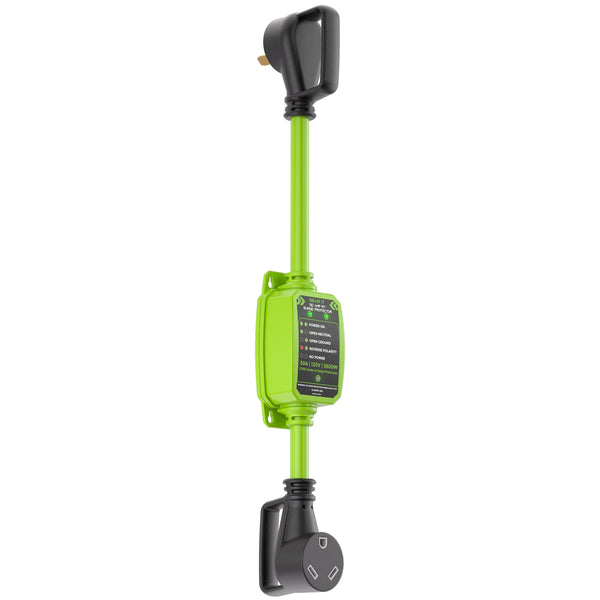
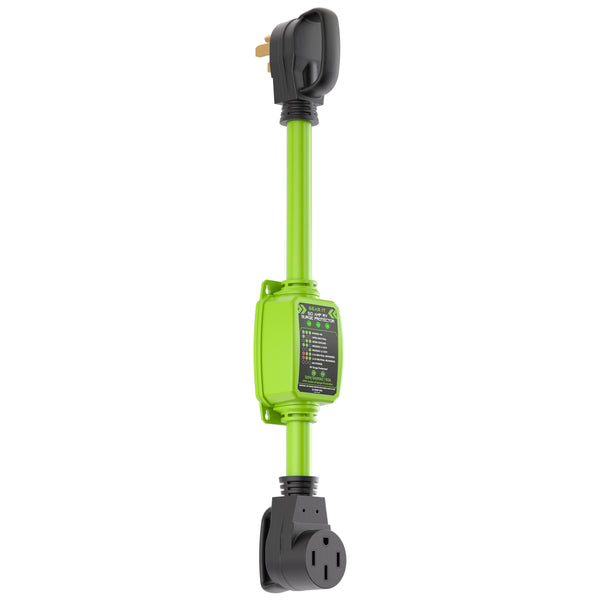
On 30A rigs, adding a compact protector between the post and your shore cord is one of the easiest safety upgrades. A practical example is the 30‑amp RV surge protector plug, which gives you fast go/no‑go feedback and surge absorption without complicating setup. For 50A coaches, choose a protector that matches your service; a unit with a built‑in analyzer can make quick work of pedestal checks before you flip breakers.
50A RV cords: capacity, copper size, and handling tradeoffs
Large fifth‑wheels and Class A rigs lean on 50A service (NEMA 14‑50) because two 120 V, 50 A legs allow more combined wattage without juggling appliances. That flexibility only pays off if your supply cable can carry the load comfortably and keep plug temperatures in the “boring” range.
- Choose the right build: 6/3 + 8/1 copper (two 6 AWG hots and 6 AWG neutral with an 8 AWG ground) is the common, dependable construction for 25–50 ft runs.
- Balance reach against drop: It’s tempting to buy a “max length” cord. If you rarely need it, extra distance just adds resistance and weight. Plan for your typical site layout.
- Pick a jacket you’ll actually coil: STW is rugged, while SJEOW keeps flexibility in cold climates. If you chase winter powder, that can be worth it.
For a deeper buyer’s view—how to read “6/3 + 8/1,” length pros and cons, jacket options, and winter handling tips—see 50A RV Cords: Copper Gauge, Jacket Type, and Cold‑Weather Flex. It ties practical selection to real campsite scenarios and shows where a heavier cord earns its keep.
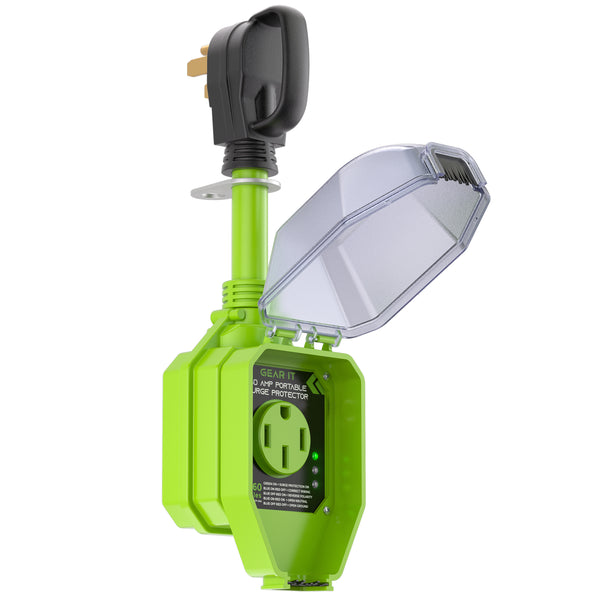
Because pedestal quality varies, many 50A owners add service‑matched protection. A 50A analyzer‑style unit helps spot low voltage or miswired posts before your A/Cs start. If you prefer a protector with integrated diagnostics, consider a weather‑resistant 50A circuit analyzer style device; it can streamline your routine into a single glance at the LEDs before you power up.
EV portable charging from a 14‑50 outlet: safer extensions and adapters
Charging an EV on a 14‑50 circuit is a practical way to add Level 2 charging in a garage or at many RV‑friendly destinations. Two best practices matter more than anything else: keep the charge current within the lowest rating in your chain, and use heavy copper conductors sized for the full branch circuit rating when you need extension length.
- Set current safely: If your portable EVSE can pull 40 A but your extension or receptacle is the limiting factor, set the EVSE to the lower limit. Treat EV charging as continuous.
- Use heavy copper for distance: For 14‑50 extensions, look for 6/3 + 8/1 copper construction. It keeps resistance—and plug temperature—under control during multi‑hour sessions.
- Mind the environment: Garages that see winter temps reward flexible jackets. Outdoor charging adds sunlight and moisture exposure; choose jackets rated for it and keep connections out of standing water.
For an end‑to‑end buyer’s view—including gauge, length, jacket, and adapter considerations—see EV Portable Charging with 14‑50 Outlets: Cable Considerations. If you’ll occasionally charge at campgrounds, that guide also shows how to approach pedestals and what to check before you rely on a site post for an overnight top‑off.
Generator cords and inlets: L14‑30 vs L5‑30, and how far you can go
Portable generators usually offer one or both of these 30A outlets. Choosing the right cord is as much about the device you’re feeding as it is about the generator itself.
- L14‑30 (120/240 V, split‑phase, locking): This is the go‑to for home transfer switches and any application expecting 120/240 V. You’ll pass both 120 V legs plus neutral and ground. Balance loads across the legs when possible.
- L5‑30 (120 V, locking): Ideal for a single 120 V, 30 A inlet—common on RVs and some portable gear. Don’t use it for 240 V loads; it’s a single‑pole connector.
Long runs between a generator and transfer switch magnify voltage drop, especially if you’re pulling close to the generator’s capacity. Most 30A locking cords use 10 AWG copper; that’s appropriate for typical 25–50 ft ranges, but be cautious beyond that and revisit your placement plan if you see dimming lights or warm plugs under sustained load.
For practical, U.S.‑focused examples—what each connector powers, how to size gauge by distance, and when adapters make sense—use Generator Cords: L14‑30 and L5‑30—What They Power and How Far.
Adapters and dogbones: safe combinations and what to avoid
Adapters are incredibly handy: you arrive at a site that doesn’t match your inlet, or you need to bridge between a generator’s outlet and your RV or tool. The key is understanding what you’re changing—and what you’re not.
- Adapters do not upgrade capacity. You’re always limited by the lowest‑rated component and the upstream breaker. A 30A RV plugging into a 50A pedestal through a dogbone is still a 30A RV.
- Poles matter: TT‑30 and L5‑30 are single‑pole 120 V. 14‑50 and L14‑30 are split‑phase 120/240 V. Be sure the device you’re feeding expects the voltage you’re presenting.
- Watch cord gauge on adapters with length: Even short adapters should use copper sized for the service to avoid heat buildup at the plug.
For a clear, scenario‑driven walkthrough of common pairings at U.S. campgrounds, residences, and marinas—including which to use and which to leave in the bin—see Adapters and Dogbones: Safe Combinations and What to Avoid.
Some adapters go from a travel‑trailer TT‑30 plug to a locking L5‑30 receptacle for equipment that expects 120 V on a twist‑lock. If you need that format to connect a 120 V, 30 A device safely, a dedicated adapter like a TT‑30P to L5‑30R cord can simplify your setup. One example built for outdoor use is the 30‑amp TT‑30P to L5‑30R generator/RV adapter cord, which uses 10 AWG copper to match the 30 A rating.
Trailer towing power: understanding 7‑way wiring for lights, brakes, and charging
For campers and cargo trailers that tow behind a vehicle, the 7‑way RV blade connector carries brake lights, turn signals, tail/marker power, trailer brake control output, and a 12 V auxiliary charge line. Good ground bonding and appropriate wire size for the charge/brake circuits prevent dim lights and weak braking, especially on longer trailers.
- Ground is the foundation: Many lighting complaints trace back to a poor ground connection. Verify continuity and clean metal‑to‑metal bonding.
- Size the 12 V auxiliary line: If you expect to maintain a house battery or power modest house loads while driving, run adequate gauge to manage voltage drop.
- Protect the junction: Use a junction box with secure connections near the tongue. It simplifies troubleshooting and future upgrades.
If you want clear pin functions, color notes, and practical sizing guidance for the charge and brake lines, see Trailer 7‑Way Wiring: Power and Brake Basics. It pairs well with the voltage‑drop planning concepts earlier in this guide.
Surge protection and EMS: matching protection to 30A vs 50A service
“Surge protector” is often a catch‑all phrase, but there are two useful layers of defense. First, devices that absorb high‑energy spikes. Second, full Electrical Management Systems (EMS) that actively monitor line conditions and disconnect your RV under sustained faults like low voltage, high voltage, open neutral, or reverse polarity.
- Match the protector to your service: 30A RVs use 30A protectors; 50A coaches use 50A protectors. Don’t mix these ratings.
- Consider EMS if you camp in high‑demand or older parks: Low voltage from heavy air‑conditioning use is common in summer; EMS units can disconnect and save you from brownout damage.
- Weather and visibility matter: Outdoor‑rated housings and easy‑to‑read indicators make checks faster and more reliable.
For a practical comparison of what each protection tier does and when EMS makes sense, read Surge Protection for RVs: 30A vs 50A and When You Need EMS. If you’re adding basic protection to a 30A rig, a compact unit like the 30‑amp RV surge protector plug is a simple first step. For 50A coaches that benefit from diagnostic visibility at the post, a 50A circuit‑analyzer‑style protector—such as a 50‑amp RV surge protector with built‑in analyzer—lets you confirm pedestal health before energizing your coach.
Troubleshooting: tripped breakers, hot plugs, and slow charging
Most power issues telegraph a message. A breaker that trips immediately under load, a plug that’s too hot to hold after an hour, or an EVSE that falls short of its advertised current all hint at something fixable: an overload, a wiring fault, or a cord that’s the wrong gauge for the distance.
- Overload the easy way: Space heaters and hair dryers commonly max out 15/20 A branch circuits. On a 30A RV, running the A/C, microwave, and other appliances together can crest the limit.
- Immediate trips: Short circuits or ground faults trip fast. Don’t force resets on a breaker that won’t hold; diagnose the circuit.
- Warm or discolored blades: Heat often points to loose receptacle contacts or a high‑resistance plug from wear or under‑gauge cords on long runs.
For a structured, safety‑first process—what to shut down, what to feel, what to inspect, and when to call a pro—keep Troubleshooting Tripped Breakers and Hot Plugs close. It’s a practical field checklist for home, jobsite, or campsite conditions.
Choosing cord length without guesswork
Right‑sizing cord length is equal parts convenience and performance. Each extra foot adds resistance you’ll pay for in voltage at the load. A few tips keep decisions objective instead of guessy:
- Measure your typical span: Pace or tape from the usual pedestal location to your RV inlet or from a garage receptacle to your EV.
- Buy for 80% of your maximum need: Most campsites and garages vary a little. A cord that covers eight out of ten scenarios keeps weight and drop in check. For outliers, a shorter “booster” extension in the same gauge can help without permanently hauling extra copper.
- Use the drop calculator when in doubt: A quick check with the values in Voltage Drop Calculator: Picking the Right Gauge by Length (30A/50A) validates the choice.
Decision matrix: match connector, gauge, and jacket to your use case
Use this matrix to pick a solid default. Adjust one step heavier on gauge or jacket if your environment is harsh (extreme heat/cold, frequent dragging across pavement) or your distances are at the long end of the range.
| Use Case | Connector | Typical Length | Recommended Copper | Jacket |
|---|---|---|---|---|
| Travel trailer at U.S. campground | TT‑30 | 25–50 ft | 10 AWG (30 A) | SJTW for easy handling; STW for tougher duty |
| Large fifth‑wheel/Class A at full‑hookup | 14‑50 | 25–50 ft | 6/3 + 8/1 | STW for durability; SJEOW in winter climates |
| Home generator to transfer switch | L14‑30 | 25–50 ft | 10 AWG (30 A) | STW rugged, visible color preferred |
| Single‑circuit 120 V generator feed | L5‑30 | 25–50 ft | 10 AWG (30 A) | STW or SJEOW based on climate |
| Portable EV charging from 14‑50 | 14‑50 | 10–30 ft | 6/3 + 8/1 | Outdoor‑rated; SJEOW if coiled in cold garages |
Real‑world product fits: where a specific cord or protector earns its place
Most buyers only need a handful of well‑chosen pieces to cover daily RV sites, the occasional generator use, and an EV charging session in the driveway. Here are a few scenarios where a purpose‑built item solves a recurring problem efficiently:
- 30A RVs that want a clean, fast safety check at the post: A compact inline protector such as the 30‑amp RV surge protector plug makes the go/no‑go step simple and reduces setup time.
- 50A RVs that benefit from diagnostics: If you prefer seeing pedestal status before switching on coach breakers, a 50A analyzer‑style protector like a 50‑amp RV surge protector with circuit analyzer combines protection with quick, readable feedback.
- RV or generator gear that needs a TT‑30 extension: When you need extra reach on a 30A RV‑style connection, a heavy‑duty TT‑30 extension like the 30‑amp TT‑30P to TT‑30R extension cord uses 10 AWG copper and an outdoor‑rated jacket for dependable runs at typical campsite distances.
- Bridging a TT‑30 source to a 120 V locking inlet: If a device expects a locking 30A, 120 V input, the 30‑amp TT‑30P to L5‑30R generator/RV adapter cord avoids daisy‑chains and preserves the correct 120 V single‑pole feed.
Seasonal care and storage: keep cords reliable year‑round
Cold snaps and summer heat both expose weak links. Cracked jackets, partially melted blades, and stiff coils are common signs of gear that needs attention or an upgrade in jacket type. A short, seasonal routine extends service life and avoids problems under peak demand.
- Inspect before the first freeze: Look for cuts, flat spots, or brittle bends. Replace anything showing copper or cracked insulation.
- Check plugs and strain reliefs: Discoloration or wobble at the base of a plug suggests heat cycling or stress; don’t ignore it.
- Match jacket to climate: SJEOW stays flexible in winter; STW resists abrasion in rough setups; SJTW handles most moderate outdoor work and coils easily.
- Store smart: Clean off grit, coil loosely, and avoid tight bends against cold walls or floors.
If you want a ready‑to‑use checklist that covers cords, adapters, surge protection, and portable power accessories ahead of freezing weather, use Winterizing Your Power Gear: Inspection and Care. It pairs practical inspection steps with quick fixes and links back to troubleshooting when something fails a check.
Putting it all together at the campsite: a smart, repeatable routine
Small, repeatable steps prevent big problems. Here’s a campsite routine that keeps voltage stable, plugs cool, and breakers happy:
- Before you arrive: Pack a service‑matched cord and a protector that matches your inlet. If you’re new to 30A vs 50A differences, refresh with RV Power Basics: TT‑30 vs 14‑50 Explained with Use Cases.
- At the post: With breakers off, plug your analyzer or protector into the pedestal. Read status, then connect your shore cord. If you want the full pre‑plug drill summarized, use Campground Hookups Checklist: Before You Plug In.
- Balance and manage loads: On 30A service, avoid running A/C, microwave, and other heavy loads at once. On 50A service, distribute big draws across legs when possible.
- Feel for heat after 15–30 minutes: Warm is normal; hot to the touch isn’t. If a plug runs hot, reduce load, shorten the cord if possible, or inspect for worn contacts. For a methodical approach, go to Troubleshooting Tripped Breakers and Hot Plugs.
Putting it all together at home: EV charging and generator readiness
At home, the same principles apply—just with a garage receptacle or generator inlet instead of a campsite pedestal.
- EV charging: If your portable EVSE uses 14‑50, right‑size any extension with 6/3 + 8/1 copper and set the charge current to the lowest rating in your chain. For planning scenarios and adapter notes, see EV Portable Charging with 14‑50 Outlets: Cable Considerations.
- Generator readiness: Confirm whether your transfer setup expects L14‑30 or if you’re feeding a single 120 V inlet with L5‑30. Keep the cord coiled and tested; longer distances deserve a sanity check against voltage‑drop guidance in Generator Cords: L14‑30 and L5‑30—What They Power and How Far.
- Adapters you actually need: Audit your bins once a season. If you find chains of reducers and splitters, swap them for a single, correct dogbone from Adapters and Dogbones: Safe Combinations and What to Avoid.
Common pitfalls—and simple ways to avoid them
- Buying by length first: Extra length is attractive but costly in voltage. Measure your typical span and choose based on the drop you can accept.
- Ignoring jacket choice: If you dread coiling your cord, you’ll abuse it. Pick a jacket you’ll actually handle, especially in cold weather.
- Daisy‑chaining adapters: Every extra contact is another heat point. Replace chains with a single, appropriate adapter.
- Skipping pedestal checks: A 30‑second glance at a protector’s LEDs can save an afternoon of troubleshooting.
- Mismatching service ratings: Keep 30A gear with 30A gear and 50A with 50A unless a specific adapter is designed for the scenario and you understand the limits.
Key takeaways
- Identify your connector first—TT‑30, 14‑50, L14‑30, or L5‑30—then match cord gauge and jacket to distance and environment.
- Plan for voltage drop using realistic lengths. When in doubt, consult Voltage Drop Calculator: Picking the Right Gauge by Length (30A/50A).
- Use adapters deliberately and keep chains short. For safe pairings and what to avoid, lean on Adapters and Dogbones: Safe Combinations and What to Avoid.
- Add right‑sized protection that matches 30A or 50A service. See Surge Protection for RVs: 30A vs 50A and When You Need EMS for when EMS is worth it.
- Adopt simple routines—the arrival checklist from Campground Hookups Checklist: Before You Plug In and the seasonal checks in Winterizing Your Power Gear: Inspection and Care—to keep plugs cool and gear reliable.
Frequently Asked Questions
How do I choose between TT‑30 and 14‑50 service for an RV?
Match what your RV is built for. Travel trailers and many Class C rigs use TT‑30 (30 A at 120 V). Larger fifth‑wheels and Class A coaches use 14‑50 (two 120 V, 50 A legs) to support higher combined loads. If you’re unsure which plug your rig needs and what it can run, start with RV Power Basics: TT‑30 vs 14‑50 Explained with Use Cases.
What cord gauge should I buy for a 50A RV?
For typical 25–50 ft runs, a cord built with 6/3 + 8/1 copper (two 6 AWG hots and 6 AWG neutral with an 8 AWG ground) is the dependable default. Keep length reasonable to limit voltage drop, and choose a jacket you can handle in your climate. For a deeper buyer’s breakdown, see 50A RV Cords: Copper Gauge, Jacket Type, and Cold‑Weather Flex.
Can I charge an EV with a 14‑50 extension cord?
Yes—if it’s constructed for the full circuit rating (6/3 + 8/1 copper with an outdoor‑rated jacket), and you set the EVSE current to the lowest rating in your chain. Keep extension length modest to limit voltage drop and plug heat. For practical selection tips, read EV Portable Charging with 14‑50 Outlets: Cable Considerations.
Why does my breaker trip or my plug run hot after I hook up?
Common causes include overload (too many watts on the circuit), a fault (short or ground fault), worn receptacle contacts, or a cord that’s undersized for the distance and load. Start with a cool‑down, one reset only, and a quick inspection. A structured, step‑by‑step approach is outlined in Troubleshooting Tripped Breakers and Hot Plugs.
Where to go next
- Confirm the plug your rig actually needs with RV Power Basics: TT‑30 vs 14‑50 Explained with Use Cases.
- Size your next cord in minutes using Voltage Drop Calculator: Picking the Right Gauge by Length (30A/50A).
- Set a safe routine at the post with Campground Hookups Checklist: Before You Plug In.
- Choose jackets and store gear the right way with Outdoor Use: STW vs SJTW Jackets, IP Ratings, and Storage.