

Audiophiles spend hours fine‑tuning amplifiers, swapping DACs, and tweaking crossover settings, yet the humble speaker lead still determines how faithfully that curated signal reaches the drivers. Choosing the best speaker cable guarantees every watt travels with minimal resistance and maximal clarity, bringing recordings to life whether you’re mixing in a studio or relaxing with vinyl at home. This guide walks through cable science, application‑specific tips, and five GEARit solutions engineered to make any system sing.
Understanding Speaker‑Cable Fundamentals
A cable may appear simple, consisting of two insulated conductors, but its electrical properties significantly influence frequency response, damping factor, and ultimately, the sound you hear. Selecting the right gauge, conductor metal, and geometry removes silent bottlenecks long before you press play.
Gauge and Resistance
Thicker wire equals lower resistance; that keeps amplifier damping high so woofers stop on a dime rather than smearing bass notes. Upgrading to 12 AWG oxygen-free copper slashes signal loss compared with the skinny leads bundled with budget RCA cables, and its larger cross‑section grips securely inside five‑way binding posts without stray strands that can cause hum on pickup. Crimped spade connectors or banana plugs keep that connection rock‑solid even when subs rattle the cabinet, ensuring every kick‑drum transient arrives cleanly.
Longer venues amplify these effects, because resistance and inductance accumulate with every foot of copper. A 75‑foot span across a church nave can bleed more than a decibel if undersized, forcing techs to drive amps hard and risking thermal shutdown mid‑service, whereas silver‑plated or silver conductors in a hefty four‑conductor bundle wired like a coaxial cable maintain headroom for soaring choirs. Starting with the right gauge early eliminates last‑minute EQ boosts, preserves dynamics, and keeps hardware cool for years of touring duty.
Conductor Material: OFC vs. CCA
Oxygen‑free copper (OFC) boasts higher conductivity and corrosion resistance than copper‑clad aluminum (CCA), making it the audiophile’s default. Over the years, OFC strands stay bright, avoiding the resistive oxide layer that forms on cheaper alloys and introduces hiss at low volumes. That stability justifies the modest cost bump when audio signal integrity matters.
CCA still has a place in budget PA installs or temporary event rigs because its lighter weight eases overhead rigging. Just remember to oversize by two gauges to match OFC resistance and monitor terminations for creep under high current.
Cable Geometry and Dielectric
Twisted‑pair construction rejects electromagnetic noise from dimmers, stage lighting, and power transformers. Spacing conductors evenly also keeps inductance low, preserving treble extension so cymbal shimmer doesn’t dull over distance. Dielectric choice, such as PVC, PE, or foamed polypropylene, sets capacitance; lower values keep impedance flat, preventing tube amps from sounding bloated in the bass.
Premium jackets matter beyond aesthetics. A braided nylon sleeve shrugs off road‑case chafing, while CL2/CL3 PVC meets fire codes inside walls. Choose plenum‑rated insulation (CMP) for HVAC ducts to comply with building inspectors and protect occupants in an emergency.
Matching Cable to Every Application
Speaker systems vary wildly: a cozy 2.1 desktop, a multi‑zone whole‑home setup, or a thumping festival line array. Tailoring cable specs to each scenario maximizes performance without overspending.
Home Theater Runs
Living‑room rigs rarely exceed 30 feet, so 14‑AWG oxygen‑free copper is a cost‑effective sweet spot for immersive 5.1 and 7.1 layouts, yet stepping up to 12AWG bare copper unlocks extra headroom in high-end sound systems where micro‑detail counts. Pre‑terminated banana plugs from a trusted cable company clamp firmly to binding posts, preventing stray strands and preserving cymbal shimmer with clear reflection rather than fuzzy bloom. Flat‑jacket audiophile speaker cables disappear beneath rugs, sustaining full‑bandwidth power to surrounds without drilling floors or lowering the living room’s WAF.
In‑wall‑rated CL2 conductors future‑proof remodels: pull extra pairs behind drywall, land them on binding‑post wall plates, and you can re‑zone a hi-fi system or add ceiling Atmos channels without fishing wires later. The same infrastructure supports studio workflows—simply swap the speaker leads for balanced instrument cables—showing how smart planning feeds both casual movie nights and high-fidelity audio systems in one seamless install.
Stereo Listening Rooms
Two‑channel purists obsess over detail, whether they’re driving vintage Bose 901 speakers or modern horn‑loaded towers. Hence, they reach for 12 AWG OFC with low‑smoke zero‑halogen jackets to minimize dielectric absorption and tame static in carpeted rooms.
Many audiophiles add bi‑wire assemblies—separate leads for high and low frequencies—so external crossovers can sculpt tonal balance precisely, exposing micro‑dynamics in jazz brushwork and vocal breath. Compare any boutique brand proclaiming itself the “world's best cable” with a well‑engineered run, and you’ll find measurements trump hype.
Never tight figure‑eights that stress copper strands and turn a bass amp speaker cable into an unintended inductor. Shoppers searching GEARit’s catalog can use the filter system to find the best match for a studio guitar amp or patio loudspeaker, thanks to a streamlined search experience that puts gauge, jacket, and termination options front and center in the main content of each product page.
Outdoor and Venue Installs
Patios, pool decks, and amphitheaters demand UV‑stabilized, direct‑burial jackets rated CL3 or sunlight‑resistant PE. Moisture‑blocking gels inside conductors prevent corrosion that would otherwise creep up strands and raise resistance. When trenching between pergola posts, route in flexible conduit to thwart rodent teeth and landscaper shovels.
For large PA hangs, consider a 4‑conductor cable that carries stereo pair or bi‑amp feeds in one sheath, cutting rigging time and weight across trusses. Locking Speakon connectors ensure foolproof mating during quick changeovers between acts.
Car Audio Builds
Tight chassis spaces and vibration call for finely stranded 16‑AWG OFC wrapped in tough PVC. Heat‑resistant jackets withstand engine‑bay warmth, while color‑coded polarity reduces install errors behind trim panels. Run cables opposite power leads to avoid alternator whine; twisted geometry plus proper grounding cure most noise issues before they start.
When routing under carpet, use split‑loom tubing to prevent screw punctures and seat‑rail abrasion. Secure with OEM clips so passengers never feel bulges under floor mats.
GEARit Speaker Cable Lineup
GEARit engineers each model to exceed ANSI/CTA‑2015 signal criteria and backs every spool with a lifetime warranty.
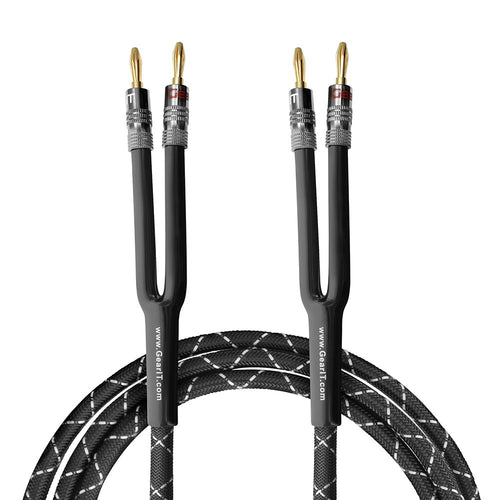
GEARit 12 AWG Premium Heavy‑Duty Braided Speaker Wire with Banana Plugs (Black)

This flagship lead pairs 409‑strand OFC conductors with a tight nylon braid that resists scuffs behind rack rails. Factory‑fitted, dual gold‑plated banana plugs ensure 360° contact and tool‑free swaps during amplifier shootouts. Meters are printed on the jacket every foot, letting installers cut symmetrical lengths in seconds.
A second dielectric layer dampens micro‑vibrations, preserving stereo imaging during high‑SPL playback. Rated 300 V, it handles class‑D amp peaks without insulation creep, making it a studio favorite for reference monitors.
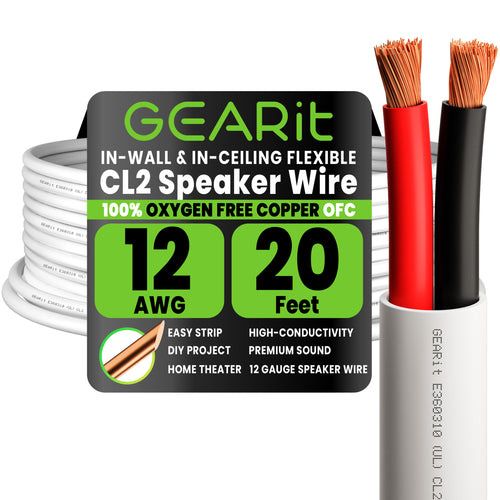
GEARit 12 AWG CL2‑Rated In‑Wall OFC Speaker Wire
Designed for new‑construction runs, this white PVC jacket meets NEC CL2 flame tests, satisfying inspectors on residential and light‑commercial sites. Oxygen‑free copper strands maintain low inductance up to 100 feet, keeping Dolby Atmos height channels punchy and clear.
Rip‑cord and footage count simplify strip‑back and conduit pulls, while polarity markings avert mis‑wires behind drywall. Pair with spring‑clip wall plates for a flush, furniture‑friendly finish that homeowners love.
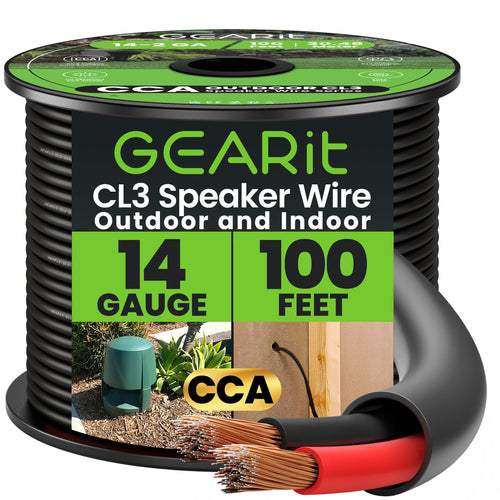
GEARit 14 AWG Outdoor Speaker Wire CL3 Direct Burial

Black polyethylene armor shrugs off UV, acid rain, and shovel strikes, making this cable ideal for landscape zones or patio zones. Oxygen‑free copper cores and a water‑blocking tape thwart corrosion, ensuring backyard playlists stay distortion‑free season after season.
Tri‑rated for direct burial, in‑wall, and conduit use, the cable streamlines inventory: one spool covers pergola speakers today and garden path lighting tomorrow—just terminate accordingly.
GEARit 14 AWG 4‑Conductor Direct‑Burial Speaker Wire (Bi‑Wire)
Four color‑coded conductors in one sheath halve trenching labor for bi‑amp setups or stereo rock speakers. Foamed PE dielectric cuts capacitance, preserving highs over 150‑foot property lines. An extra‑thick sunlight‑resistant jacket resists weed‑whacker nicks.
Contractors praise the printed footage marks every two feet—no tape measures needed when staging multiple zones. Pair with waterproof gel‑filled splice kits for code‑compliant lawn installs.
GEARit 16 AWG Premium Braided Speaker Cable with Banana Plugs (Gray)
Ideal for desktop and bookshelf rigs, this flexible braid routes easily around monitor stands and inside cable trays. Gold‑plated banana tips grip tighter than spring clips, guaranteeing full contact during head‑banging playlists.
Installation Best Practices
A stellar cable can still underperform if installed poorly. Follow these guidelines to lock in pristine signal paths.
Length and Voltage Drop
Keep total loop resistance below 5 % of speaker impedance. For 4 Ω loads, aim under 0.2 Ω—roughly 12 AWG at 25 feet or 14 AWG at 15 feet. Measure twice and trim excess rather than coiling slack, which adds inductance and acts like a low‑pass filter on tweeters.
Termination Techniques
Strip just enough insulation—about ½ inch—to seat conductors fully without stray strands. Twist the copper tight before inserting it into the bindings to prevent shorts. For set‑screw posts, tin with silver solder to stop creep; for banana plugs, use compression fittings over solder for the lowest contact resistance.
Cable Management and Safety
Support horizontal runs every 4 feet with J‑hooks or Velcro straps to avoid sag that stresses terminations. Maintain a 12‑inch separation from AC lines or cross at right angles to curb hum pickup. In risers, use fire‑rated grommets when penetrating floors.
People Also Ask
Does fancy cable break‑in improve sound?
Break‑in largely affects dielectric settlement; any change is subtle. Focus the budget on the correct gauge and conductor purity first.
Can I mix gauges in one system?
Yes, but keep left/right pairs identical to avoid tonal imbalance. Use thicker wire for longer surrounds.
Are banana plugs better than bare wire?
Plugs provide convenience and consistent contact. Bare wire is fine short‑term, but it oxidizes faster and loosens with vibrations.
How often should I inspect cables?
Annually for fixed installs; before each gig for mobile rigs. Look for frays, discoloration, or loose connectors.
Elevate Every Note—Shop GEARit Speaker Cables
Your amplifier and speakers deserve a conduit that preserves every nuance, from thunderous cinematic rumbles to delicate acoustic harmonics. Equip your system with the best speaker cable from GEARit and unlock performance headroom you can hear. Explore GEARit’s full speaker‑cable lineup, crafted in California since 2006 by connectivity enthusiasts who back every conductor with friendly, knowledgeable support, and let pristine signal flow set the stage for unforgettable sound.