

A single length of copper may seem trivial, but ask any contractor halted by a tripped breaker or a homeowner whose sump-pump quit mid-storm, and they’ll tell you: the right lead can save a workday, or a basement. Choosing the best extension cord is about far more than raw length; it’s the interplay of conductor gauge, jacket chemistry, plug geometry, and built-in protections that lets electricity travel safely from outlet to load.
This deep dive unpacks those variables, showcases five GEARit heavy-hitters purpose-built for jobs from holiday lighting to hurricane relief, and equips you with practical tips so every project stays powered, protected, and code-compliant.
The Science Behind Safe Power
Modern appliances gulp more current than ever: shop vacs that spike to 14 A on startup, welders pulling 40 A at 240 V, and even a garage air compressor that cycles all afternoon. Push that draw through undersized indoor leads and voltage sags, motors overheat, and breakers trip. Specifying ETL-listed outdoor extension cords built with 10-, 12-, or 14-AWG US wire keeps resistance low, safeguards ground continuity, and meets every published cord rating, so torque in heavy-duty power tools stays strong while jacket temperatures remain safely below UL’s 60 °C ceiling. A clearly labeled grounded extension cord removes guesswork and protects compressors, pumps, and sensitive electronics from destructive brownouts.
The jacket matters just as much. A high-visibility yellow jacket shrugs off sunlight, oil spray, and –40 °F cold without cracking, while molded strain-relief grips protect the plug-to-cable junction through thousands of yanks. Lighted female ends confirm live power at a glance on crowded sites, and triple-layer insulation blocks abrasion when cords snake across concrete. Choosing an ETL-listed, heavy-gauge lead up front means fewer failures, faster inspections, and rock-solid performance—no matter how demanding the load or how long the run.
How to Decode Ratings
Before you commit cash or unspool another lead from the extension cord reels in your truck, pause for a quick label read of your plug configuration needs. The tiny embossing along the jacket is your first layer of plug confirmation that you’re holding true industrial-grade extension cords built for heavy-duty use and error-free power transmission rather than a bargain bin substitute.
- Gauge & Conductors – “10/3” denotes three 10-AWG copper conductors (hot, neutral, ground). Lower gauge numbers indicate thicker copper, which runs cooler and keeps the ground continuity monitor satisfied during high-amp loads.
- Voltage & Amperage – 125 V / 15 A covers household tools or lawn & garden tools; 250 V / 30–50 A serves welders, dryers, and RV hookups without starving motors. Integrated power check lights on many lighted cords (usually in amber LED lighted indicators) give instant visual proof that the circuit is live and within spec.
- Jacket Code – SJTW handles everyday outdoor abuse; STW adds a thicker wall for job-site abrasion for ground continuity lights; SOOW delivers oil-resistant rubber flexibility for triple-shift factories and cold-weather pours.
Matching these specs to your equipment and double-checking them before the cord leaves the reel is the most straightforward path to guaranteed uptime.
Indoor vs. Outdoor Demands
An office remodel powering laptop bricks and 3D printers places very different stresses on cords than a roofing tear-off in sleet. Indoor leads prioritize slim profiles and flat plugs that hug the wall behind credenzas; outdoor versions favor visibility (hi-vis orange or neon green) and jackets that repel gasoline and UV rays. Surge-protected inline modules tame generator irregularities, while GFCI plugs trip in under 25 ms if moisture or nicked insulation routes current through a wet hand.
- Temperature Swing – Thermoplastic elastomer blends in GEARit’s heavy-duty lines remain pliable from –40 °F to 221 °F, preventing micro-cracks that invite arcing.
- Impact & Abrasion – Reinforced ridges and thick strain-reliefs deflect dropped hammers and slab edges.
- Water Resistance – Molded plug ears mate flush with NEMA 5-15R sockets; optional gasket boots stop splash-back when powering pond pumps or holiday inflatables.
Specialty Runs: Generator & RV Life
Storm-season blackouts make portable generators indispensable, yet most ship with stumpy 6-foot pigtails. A purpose-built generator extension cord uses 10 or 12-AWG copper, STW jackets, and locking connectors (L14-30, 14-50, or TT-30) to feed sub-panels without back-feeding the grid.
RV shorelines face similar stress: UV, mud, and constant coil-and-uncoil cycles. A cord rated 30 A at 125 V (TT-30) or 50 A at 125/250 V (14-50) keeps AC compressors humming and inverter-chargers topped during muggy nights, while heat-resistant blades maintain spring tension to prevent glowing receptacles.
Featured GEARit Heavy-Duty Extension Cords
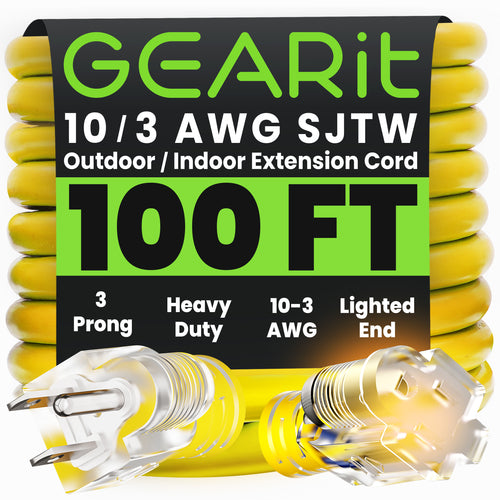
GEARit 10/3 SJTW 100 ft Ultra-Heavy-Duty Cord (Lighted Ends)

Built with 10-AWG OFC conductors and a bright LED at the female end, this line moves 15 A across a full 100 feet with less than 3% voltage drop, perfect for table saws or submersible pumps at distant corners of the job. A molded plug collar doubles as an easy-pull handle when winter gloves reduce dexterity.
The water-resistant SJTW jacket shrugs off concrete dust and diesel spills, while a temperature window of –40 °F to 221 °F keeps the vinyl pliable in Alberta winters or Arizona summers. Pair it with GEARit’s cord reel cart, and you’ll deploy or stow 100 feet in under a minute with no kinks, no knots, no downtime.
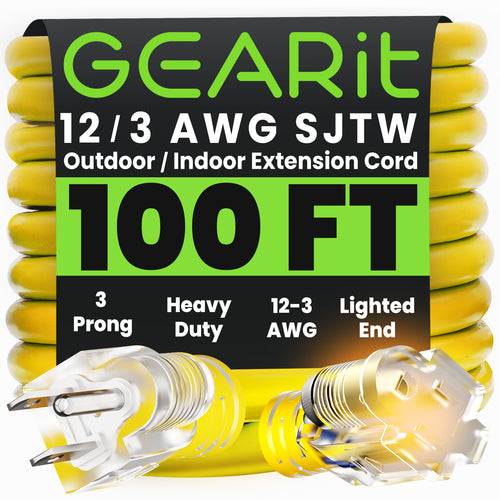
GEARit 12/3 SJTW 100 ft Extra-Heavy-Duty Cord (Lighted Ends)

Need a slightly lighter lead without sacrificing durability? This 12-AWG workhorse handles 15-A circular saws and 1,500 W space heaters with ease. Its lighted receptacle verifies live power instantly on dark stages or under crawl-space joists.
The tri-layer jacket bonds insulation to copper so thermal cycling never separates layers. A high-visibility yellow sheath meets OSHA colour-coding, minimizing trip hazards on cluttered renovation floors, while antimicrobial additives resist mold in damp basements.
GEARit 50 A 14-50P to 14-50R Generator Extension Cord (Green Jacket)
Designed for food-truck hookups and EV charging at events, this 6-foot beast uses 6/3 + 8/1 copper to pass a full 12,500 W without overheating. Molded 90-degree grips simplify disconnects after 12-hour shifts.
The vivid green jacket stands out among snaking black audio lines, and an included Velcro wrap secures coils during transit. Rated STW, it stays flexible below freezing, ideal for winter festivals or mountain cabins running dual-fuel generators.
GEARit 30 A L14-30P to L14-30R Generator Power Cord (25 ft)
This twist-lock extension bridges portable generators to transfer switches, safely carrying 7,500 W at 250 V. The locking collars resist vibrations from chugging engines so you can refuel without killing power to sump pumps or lighting rigs.
Strain-relief molded boots exceed UL pull-test standards by 50%, and a contrasting stripe along the jacket lets crews confirm orientation in low light. Every unit undergoes high-pot dielectric testing before leaving the factory, guaranteeing insulation integrity even after years of job-site abuse.
GEARit 10-30P to 10-30R 30 A Dryer-Style Cord (25 ft, STW)
Perfect for welders and plasma cutters that repurpose a laundry circuit, this 10-AWG cord maintains compliance while extending reach across garages. The stiff blades of the 10-30 plug hold tight in aging receptacles, reducing contact-resistance heat.
A flat profile at the receptacle end hugs walls behind appliances, while the rest of the STW jacket remains round for maximum abrasion resistance. Pre-installed hanging loops make wall storage tidy, and each cord ships with a break-in checklist ensuring proper load checks before the first arc.
Installation & Safety Best Practices
Respect Voltage Drop
Aim for under 5% drop: a 100-ft 12-AWG cord feeding 15 A draws roughly 1.9 V off 120 V, well within spec. Use voltage-drop calculators before committing to lengths longer than 50 feet with high-amp tools.
Measure real-world drop with a multimeter once the tool is running under load; spikes during motor start can exceed static calculations. If readings fall below 108 V, upgrade to a thicker gauge or shorten the run to avoid motor damage.
Coil & Store Correctly
Hard bends invite conductor fatigue. Coil cords in broad 12-inch loops or use over-under technique; avoid tight figure-eights that trap twists. Wipe jackets clean of grit before storage to stop abrasive wear in reels.
For generator cords, disconnect and cool before winding; hot copper softens vinyl jackets, imprinting flat spots that become weak points next deployment. Label each cord’s amp and length on gaff tape at both ends for instant ID.
Integrate Surge & GFCI Protection
Inline GFCI modules trip at 4–6 mA within 25 ms, preventing lethal shocks when rain hits live sockets. Surge-protected tap blocks clamp spikes from failing alternators or distant lightning.
Replace GFCI units after five to seven years or after any trip that shows scorch marks. Test monthly with built-in buttons and verify reset latches engage fully before powering loads.
People Also Ask
Can I chain two 50-ft heavy-duty cords instead of buying a 100-ft run?
You can, but every connection adds resistance and potential spark points. A single continuous 100-ft 12-AWG cord stays cooler and delivers higher voltage at the tool.
Does a lighted plug waste power?
The LED draws mere milliamps, less than 0.1 W, insignificant compared to the tool load. Its benefit in quick power diagnostics outweighs the minuscule consumption.
How often should I replace extension cords?
Inspect before each use; replace if insulation cracks, copper shows, or the plug blades loosen. Heavy-site cords may last two to five years; indoor leads often exceed a decade when stored properly.
Is it OK to bury an extension cord temporarily?
Only if the jacket is marked “SJTW” or “STW” and you protect connections from moisture. For long-term burial, switch to direct-bury UF cable or install conduit.
Power Every Project—Choose GEARit Heavy-Duty Leads
From hurricane prep to holiday décor, reliable current starts with the line you plug into the wall. Equip your kits with the best extension cord for every scenario, thick copper cores, weather-proof jackets, and molded grips that last longer than the projects they power.
Shop Extension Cords at GEARit, founded in 2006 by California-based connectivity enthusiasts who back every conductor with lifetime support, and never let a weak link stall your work again.